How to Design a Crypto Exchange Fee Structure (Maker-Taker Playbook)
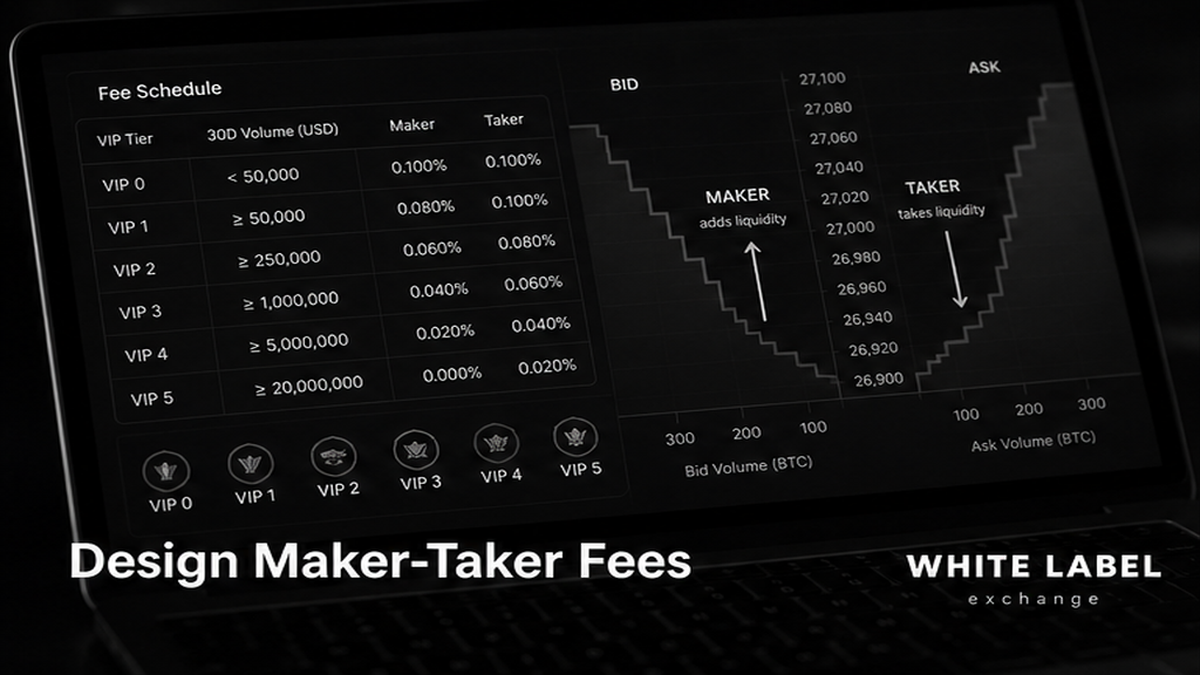
Wrong fees crush a new exchange twice: price like a premium retail venue and the order book stays empty; race to zero forever and trading margin disappears. This playbook covers crypto exchange fee structure design for operators – choose a model, ship a first-90-days maker-taker schedule with volume tiers, wire VIP and market-maker overrides, price withdrawals without scaring deposits, then publish and monitor. You leave with a launch-ready fee page and a fee-ops checklist.
TL;DR / Quick take: Default to maker-taker (makers add resting liquidity; takers remove it) if you want professional market makers. Aim near 0.08-0.10% maker / 0.10-0.12% taker – or a time-boxed 0% maker window – with 6-10 VIP tiers on a 30-day rolling volume. Keep crypto deposits free; set withdrawals as network cost plus a clear markup. Publish effective dates, then review weekly for 90 days.
A fee schedule is how you buy liquidity, protect revenue, and signal who the venue is for. Still choosing the launch path? Start with how to start a crypto exchange, then return here. Maker incentives also sit next to how to add liquidity to a new crypto exchange.
1. Choose model: flat vs maker-taker vs hybrid rebates
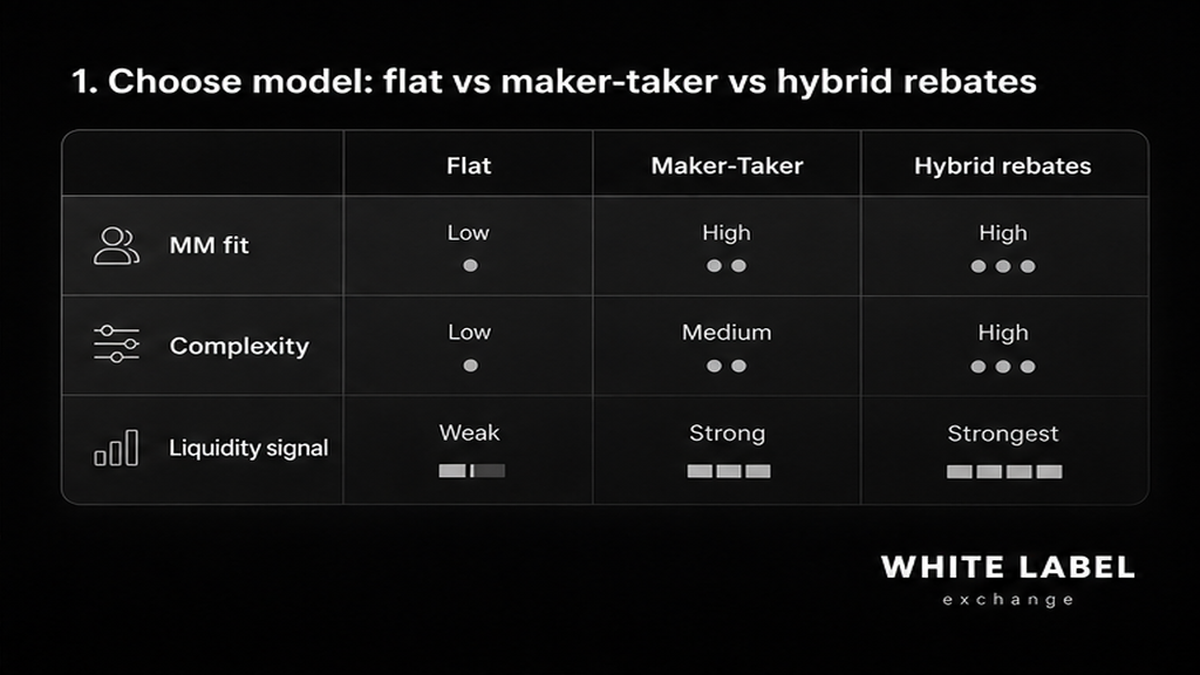
Flat fees charge the same rate whether an order adds or removes liquidity – simple for a tiny MVP, weak once you need desks that post continuous quotes. Maker-taker is the standard centralised exchange (CEX) model: makers post resting limit orders and usually pay less (or get a rebate); takers cross the spread and usually pay more. Hybrid rebates go further: makers can earn a negative fee when they keep depth and tight spreads.
Maker vs taker is about fill behaviour, not the button label. A limit that rests = maker. An order that fills immediately = taker. A basis point (bp) is 0.01%. Design guides often use a 2-10 bp maker-taker spread; 5-10 bps steady state, 10-20 bps for bootstrap; rebates commonly -0.01% to -0.02% (sometimes to -0.03% in MM deals).
- Pick maker-taker as default if you plan professional market makers (MMs).
- Use flat only for an ultra-early MVP; migrate within the first year.
- Set spread width (bootstrap 10-20 bps vs steady 5-10 bps) before naming rates.
- Do not copy Binance VIP thresholds on day 1 – you lack their volume.
Do this: write the model and spread width before you touch rates. Do not ship flat fees if MM desks are part of the launch plan.
2. Set base rates and volume tiers for your first 90 days
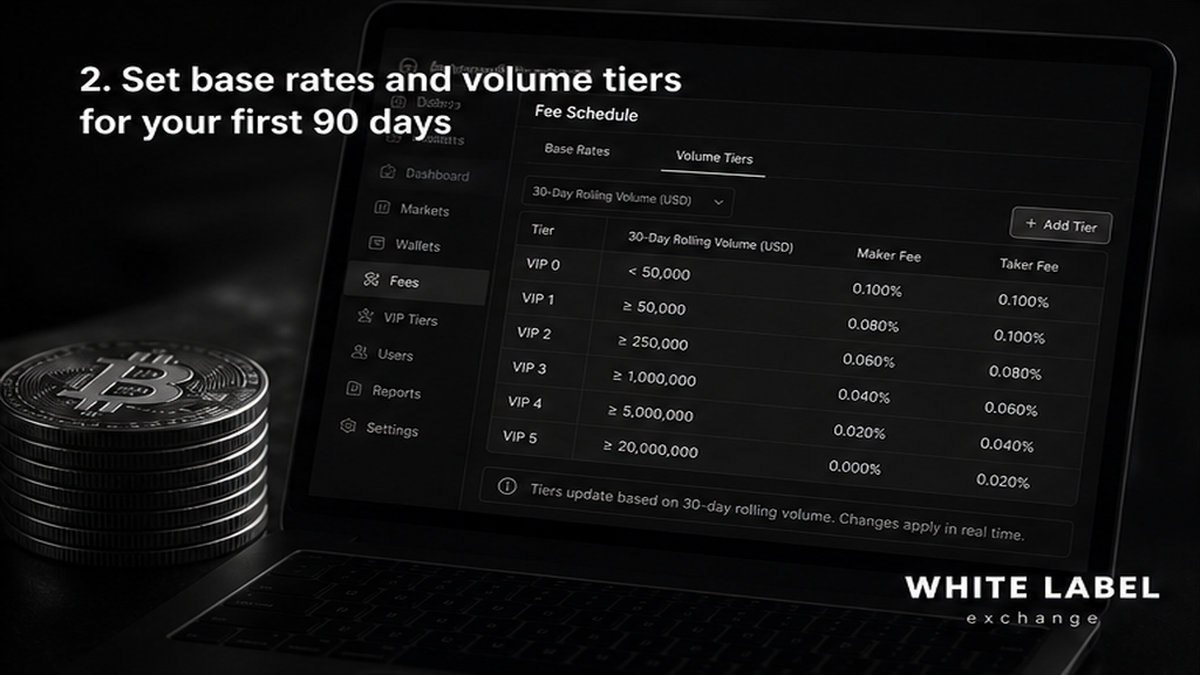
Retail sites answer “what do I pay?” Your job is to publish a schedule traders and MMs can trust for the first quarter. Mid-2026 major-venue spot bases (verify live – schedules move):
| Venue (base / entry) | Maker | Taker | Note |
|---|---|---|---|
| Binance Regular | 0.10% | 0.10% | BNB pay often ~25% off |
| OKX Regular | 0.08% | 0.10% | Often cheapest major base |
| Bybit Non-VIP | 0.10% | 0.10% | Spot crypto-crypto |
| Coinbase Exchange entry ($0-$10k) | 0.40% | 0.60% | Premium retail entry |
| Kraken Pro Tier 1 (from 2026-07-09) | 0.40% | 0.80% | Best of spot / futures / Assets on Platform |
CEX trading fees typically land in a ~0.1%-0.3% band with volume tiers. For a new venue, target roughly 0.08-0.10% maker / 0.10-0.12% taker – or temporary zero-maker. Pricing like Coinbase or Kraken Tier-1 retail without a compliance brand moat usually fails the liquidity test. A common illustrative structure is 0.10%/0.20%.
| Suggested launch ladder (illustrative) | 30-day volume | Maker / Taker |
|---|---|---|
| Standard | < $50k | 0.10% / 0.20% |
| VIP mid | scaling breakpoints | step down toward 0% |
| Top public VIP | $500M+ (template) | 0.00% / 0.03% |
- Name the competitor you undercut by ~20-30% in the fee brief.
- Publish 6-10 public tiers on a trailing 30-day rolling window (not a calendar month).
- Keep retail in higher-fee lower tiers; leave private deals above the top public tier.
- Optional: zero maker for 3-6 months, then reintroduce a small maker fee.
- Skip exchange-token discounts on day 1 unless tokenomics are ready (10-25% later is typical).
Do this: freeze a 90-day public schedule with effective dates. Do not invent 12+ VIP labels that confuse retail.
3. Configure MM overrides, VIP accounts, and launch promotions
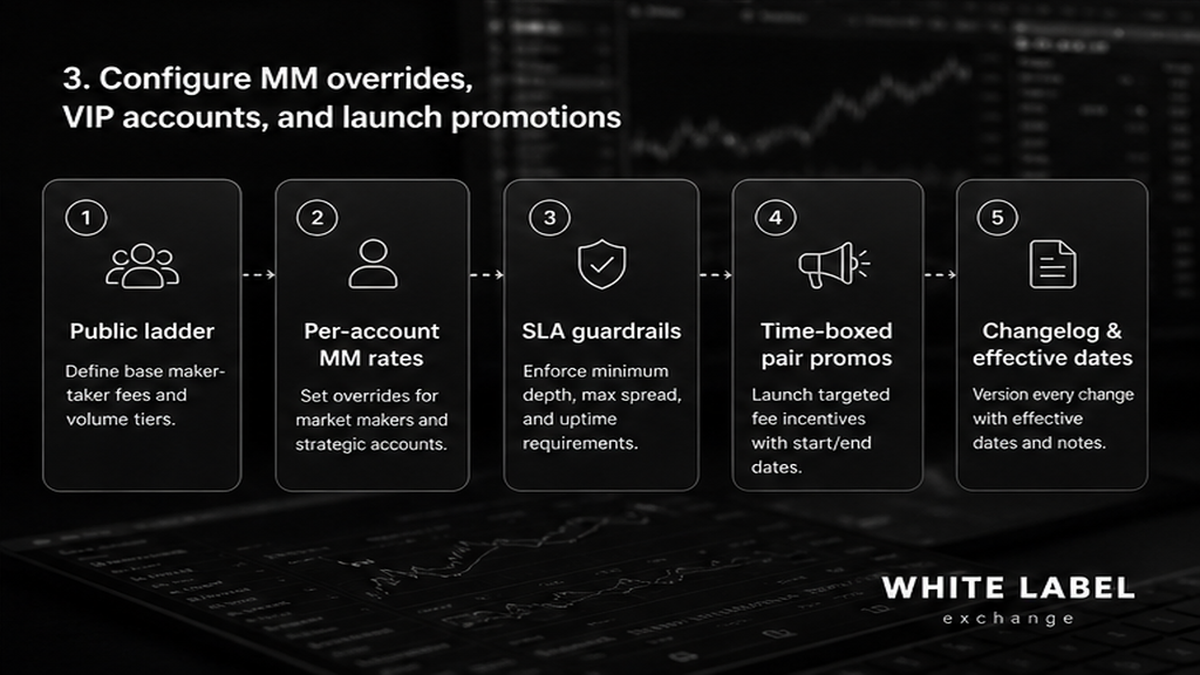
Public tiers are the shop window. Liquidity desks need private rates. Your matching engine (the software that matches buys and sells) must support per-account fee rates so one MM can get a rebate while retail stays on the published ladder.
- Enable per-account overrides before you advertise rebates.
- Sign MM SLAs with min depth, max spread, and uptime – rebates about -0.01% to -0.03% only against those obligations.
- Time-box zero-fee pair promos with hard end dates on the fee page.
- Never surprise-change VIP math mid-month without notice.
- Log every override (who, rate, pair, expiry) for rebate-burn tracking.
Workflow:
Public ladder → per-account MM rates → SLA depth/spread/uptime → time-boxed pair promos → changelog with effective dates.
Zero-fee trading is a marketing lever. Vendor guides warn that sustaining ops without trading revenue can require large alternative income (often cited around $500k+/month – directional, not a law). Do this: treat MM rebates as paid inventory. Do not run open-ended zero fees on every pair. Compare white-label vs build, or explore White Label Exchange solutions when you need fee tiers and MM overrides without a greenfield engine.
4. Price withdrawals, listing fees, and fiat rails without killing volume
Trading fees are only one lever. Withdrawals, listings, and fiat on-ramps decide whether users fund and stay.
- Crypto deposits: almost always free. Charging here trains users to keep funds elsewhere.
- Withdrawals: fee = network cost + exchange markup. Models: flat, dynamic (gas oracle), or VIP free allowances. Example flats often cited: BTC ~0.0003, ETH ~0.003, USDT TRC-20 ~1, USDT ERC-20 ~5-15 – re-check live network costs.
- Infra pattern: per-asset NETTED vs ADDITIVE withdrawal spread (fixed and/or %). Transparent markup beats opaque multipliers.
- Fiat card on-ramps: often 1.5-3.5%; third-party ~3-5% with revenue share often ~30-50%.
- Listing packages: roughly $10k-$50k standard, $50k-$200k premium; launchpad often 5-10% of raise. Quality review beats fee chasing.
Do this: publish clear withdrawal math plus VIP free-withdrawal allowances. Do not bury high withdrawal fees that kill future deposits.
5. Publish, monitor, and iterate: fee ops checklist for operators
Kraken Pro’s cross-platform tier change effective 2026-07-09 (Tier 1 at 0.40%/0.80%, Assets on Platform as a path) shows fee schedules are living products. Older listicles still quote stale bases – your page must show effective dates.
- Publish one public page for spot, futures (if live), withdrawals, and VIP rules.
- Add in-product fee preview on the order ticket (maker vs taker before click).
- Ship a changelog with effective dates.
- Track weekly for 90 days: fee mix, effective bps vs competitors, MM rebate burn, withdrawal markup vs network spikes, tier distribution, promo ROI.
- Then move to monthly once the ladder stabilises.
Fee ops loop:
Publish schedule → ticket preview → weekly mix/bps/rebate review → adjust promos or markups → changelog.
Do this: put fee ops on the same calendar as liquidity health. Do not treat the fee page as a one-time launch artefact.
What to do next
Lock maker-taker (or timed zero-maker), publish a 6-10 tier 90-day ladder, wire MM overrides with SLAs, keep deposits free and withdrawals transparent, then run the weekly fee-ops checklist. More: White Label Exchange blog. Need fee tiers built in? Talk via whitelabelexchange.io.
Reviewed by: White Label Exchange Editorial (practitioners in white-label exchanges, exchangers, P2P, and fee/liquidity ops).
Data integrity: spot benchmarks cite official venue materials (Binance, OKX, Bybit, Coinbase, Kraken July 2026). Operator ranges for spreads, VIP size, withdrawals, listings, and launch templates follow Codono/Peiko guides as industry practice, not guarantees. RU Wordstat proxies checked 2026-07-19; English primary-phrase volumes were not invented.
Frequently asked questions
What is a good maker/taker fee for a new exchange?
Start near 0.08-0.10% maker / 0.10-0.12% taker, or 0% maker for a timed launch. Stay well below Coinbase Advanced retail entry (0.40%/0.60%) unless compliance UX is your wedge. Undercut your named competitor by about 20-30% for the first quarter.
Should new exchanges offer zero maker fees?
Yes as a timed promo – often 3-6 months – to bootstrap books. Then introduce a small maker fee so taker revenue is not alone funding rebates. Pair rebates with written depth and uptime obligations for MMs.
How to set withdrawal fees without hurting deposits?
Keep crypto deposits free. Set withdrawals as network cost plus a transparent markup; offer VIP free-withdrawal allowances; prefer dynamic fees when gas is volatile. High opaque withdrawal fees push users to fund elsewhere and never return.
How many VIP tiers do I need at launch?
Six to ten public tiers on a 30-day rolling volume is enough. Fewer than five is too coarse; more than twelve confuses retail. Add private MM/OTC rates outside the public table.
Flat fee or maker-taker?
Choose maker-taker if you want professional liquidity. Use flat only for tiny MVP simplicity, and plan to migrate within the first year once desks and VIP accounts arrive.
Do I need an exchange token for discounts on day 1?
No. Ship clear maker-taker plus VIP first. Add a 10-25% token discount later if tokenomics are ready, following the BNB-style pattern rather than launching tokenomics and fees together.