How to List Tokens on Your Crypto Exchange: Operator Checklist
Ad-hoc token listings look fast until a thin book hurts a client and compliance asks for a paper trail you never wrote. The fix is an operator checklist: publish policy, run due diligence, integrate wallets and pairs, price the commercial pack, then stage listing day with a 14-day monitor. Finish this playbook and you can approve or refuse a coin with written go/no-go rules – not FOMO.
TL;DR / Quick take: Treat listing as an operating system, not a favor to issuers. Publish criteria before the first application, require a full data room (entity, audits, market-maker plan), finish tech tests before marketing, unbundle fees so depth gets funded, and open deposits → trading → withdrawals in that order. Keep pause and delist triggers for the first two weeks.
This guide is for exchange operators and white-label founders – not projects hunting a Tier-1 slot. Coinbase and Kraken share the same spine: policy, review, integrate, launch, monitor. Pair with your compliance checklist and liquidity playbook.
1. Define listing policy before the first application
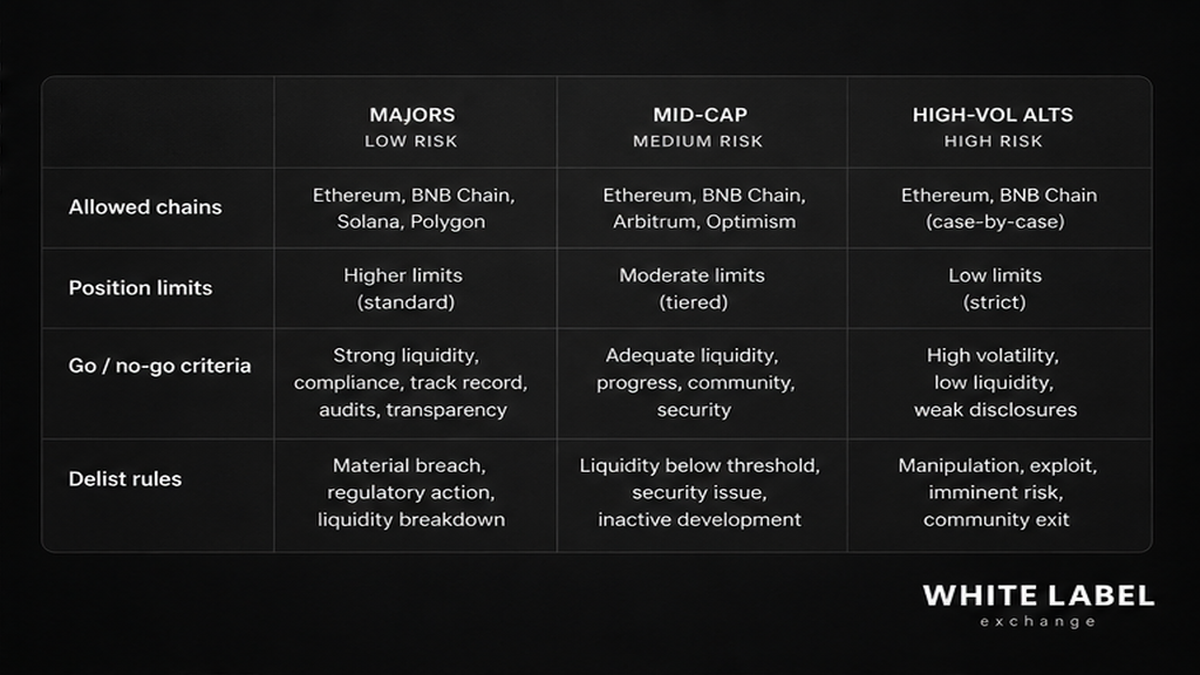
Write the rules while the inbox is empty. A listing policy says which assets you consider, how you decide, and how you remove them. Cover scope, criteria, procedure, AML/CFT (anti-money-laundering controls), disclosure, delisting, and liability.
- Allowed chains and standards (ERC-20, TRC-20, BEP-20) and first pairs (usually TOKEN/USDT).
- Risk tiers – majors, mid-cap, high-volatility alts – with different position limits.
- Go/no-go criteria for legal, technical, financial, AML, and market quality.
- Listing committee quorum, memo template, and pause authority.
- Fee/SLA disclosure plus pause and delist rules users understand.
Do: publish the policy (or a clear summary) before marketing “we list anything.” Don’t: invent criteria mid-deal because a rival listed first.
2. Run issuer due diligence with a weighted scorecard
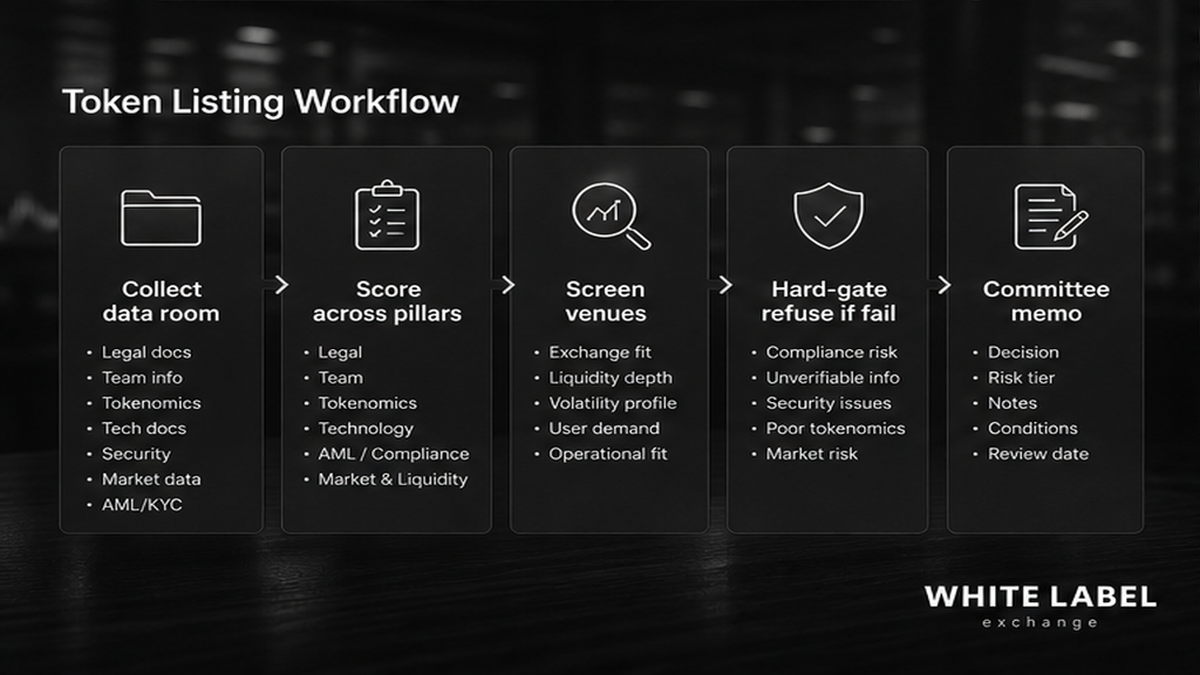
Standardize intake so every issuer sends one pack. KYB (know your business – verifying the company) and beneficial ownership (who controls the entity) belong there, not in chat.
- Collect the data room: incorporation, beneficial owners, team KYB, whitepaper/tokenomics with vesting, contract address, explorer links, public audit URLs, legal opinion (MiCA whitepaper status for EEA), AML policies, and market-maker LOI.
- Score with weights (policy example): Legal 20%, Team/BO 15%, Tokenomics 20%, Technical 20%, AML/sanctions 15%, Reputation/market 10%. Exceptions need written risk acceptance.
- Screen the market: many operators want the token on ≥2 reputable venues with roughly $2–5M combined 24h volume.
- Refuse hard gates: unresolved high/critical audits, missing owners, sanctions hits, unclear securities status, or no liquidity plan.
- Record the committee memo – approve, refuse, or escalate. Never flip live on FOMO alone.
A structured review can take about 3–6 hours once policy exists; ad-hoc gaps have been reported to drive costly remediation after a bad listing (Spencer Logic scenario – illustrative).
Do: require independent audits with remediation evidence when risk is material. Don’t: accept “audit coming next month” as go-live.
3. Finish technical go-live before the announcement
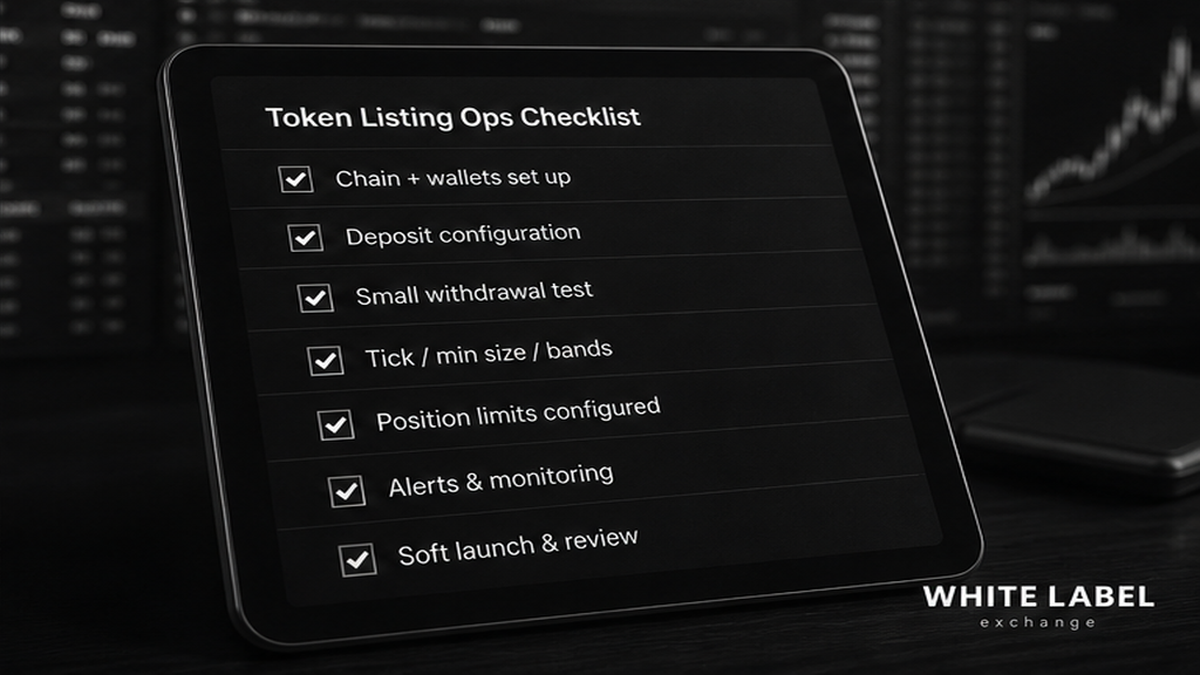
Marketing without wallet tests invents a support crisis. Go-live means chain, custody, matching, and alerts work in staging with a signed checklist.
- Enable chain support in hot and cold wallets (hot = online keys for small flows; cold = offline storage for larger balances). Hot-only for large balances is a security debt.
- Configure deposit addresses and confirmation counts.
- Run a small withdrawal test end-to-end before public open.
- Set matching parameters: tick size (smallest price step), min order size, and price bands that reject absurd prints.
- Apply risk overlays: position limits; if average daily moves exceed ~15%, tighten limits from day one and keep a 48–72h soft-launch window.
- Wire monitoring for deposit/withdrawal failures, explorer mismatches, unusual order patterns, and a named on-call owner.
Tech workflow:
Chain + wallets → deposit config → small withdrawal test → tick / min size / bands → position limits → alerts → soft launch.
New-chain deposit/withdrawal work often takes 2–8 weeks; familiar EVM tokens on a white-label stack move faster. Overlays from scratch can take 6–10 weeks versus days when matching, wallets, and templates already ship together.
Do: gate withdrawals until monitoring looks solid. Don’t: announce while confirmations are still “best effort.”
4. Price the commercial pack without killing volume
A “cheap listing fee” means little until you unbundle: cash fee, refundable deposit, market-maker quoting SLA (who posts continuous buy/sell quotes), maker-taker overrides, marketing window, and volume/delist clauses.
| Line item | What it buys | Operator note |
|---|---|---|
| Cash listing fee | Review + ops + calendar slot | Tier-1 often $0, merit-based |
| Security deposit | Remediation buffer | Size to your risk |
| MM retainer / SLA | Day-1 spread and 2% depth | Often ~$15k–$50k/month reported; empty books cost more than a lower fee |
| Maker-taker overrides | Early liquidity incentives | Align with fee structure design |
| Delist / volume clauses | Exit if liquidity dies | Write remediation windows pre-launch |
Industry-reported Tier-1 bands (framing only) put listing fees about $100k–$3M. On a new venue, price so projects can fund market-maker depth first.
Do: put day-1 depth and spread targets in the agreement. Don’t: take a high cash fee and skip the MM SLA.
5. Operator checklist: approve, stage, announce, monitor 14 days
Copy the Tier-1 phased rollout: deposits first, optional auction or limit-only window, then trading, then withdrawals when monitoring looks clean.
- Committee memo signed with risk tier and soft-launch limits.
- Listing agreement executed (fees, MM SLA, delist clauses).
- Wallet + pair config verified; small withdrawal test passed.
- Monitoring tags and on-call owner assigned.
- Public calendar published (deposits → trading → withdrawals).
- Deposits opened; balances and confirmation times checked live.
- Trading enabled (optional auction or limit-only warm-up).
- Withdrawals opened after monitoring confidence.
- Pause playbook ready (who decides, how users are notified).
- 14-day monitor board live: volume, spread, 2% depth, fill quality, unusual patterns, tickets, on-chain anomalies.
- Soft limits kept if volatility breaches policy.
- Week-2 go/no-go: keep, extend soft limits, remediate, or start delist.
Listing-day sequence:
Announce calendar → open deposits → enable trading (optional auction) → open withdrawals → 14-day monitor → keep / remediate / delist.
Refuse/delist path: remediate → notify issuer and users → restrict deposits/buys → remove pairs → withdrawal exit window. Document the trail early.
In-house listing tooling can take weeks. A white-label stack with matching, wallets, and risk templates turns listing into configuration – explore White Label Exchange solutions if that path fits.
Do: keep written pause authority on listing week. Don’t: open withdrawals before you trust telemetry.
What to do next
- Publish listing policy with risk tiers and delist rules.
- Ship one intake form + data-room checklist for every issuer.
- Run the next candidate through the scorecard and committee memo.
- Complete wallet/pair tests before any marketing slot.
- Lock the commercial pack and deposits → trading → withdrawals sequence.
More guides on the White Label Exchange blog. Still shaping the venue? See how to start a crypto exchange.
Fact-checked: White Label Exchange Editorial.
Data note: Wordstat (region 225) checked 2026-08-14; benchmarks from Coinbase, Kraken, COREDO, Spencer Logic, and fee explainers in research notes. Not legal or investment advice.
Frequently asked questions
What documents should an exchange require before listing a token?
Require incorporation and beneficial ownership, team KYB, whitepaper/tokenomics with vesting, public audit(s) with critical/high issues remediated, a legal opinion (MiCA whitepaper path for EEA), AML policies, a market-maker agreement, and verified explorer plus contract address. Incomplete packs go back to intake.
How should operators set listing fees without killing volume?
Unbundle cash fee, deposit, MM obligations, and campaigns. Benchmark Tier-1 free merit-based models versus mid-tier paid listings, then price so projects can fund day-1 depth first. Empty books cost more than a cheap fee.
When should operators refuse or delist a coin?
Refuse for unresolved high/critical audits, missing beneficial owners, sanctions hits, unclear securities status, or no MM plan. Delist after remediation for illiquidity, tech failures, manipulation, regulatory orders, or an abandoned project – always with a withdrawal exit path.
What is a safe listing-day sequence?
Open deposits first, enable trading next (optional auction or limit-only window), then open withdrawals after monitoring looks stable. Keep pause authority with a named owner on listing week.
How long does a proper listing take on a new or white-label exchange?
Checklist review can be hours once policy exists. Wallet/pair work often takes days to a few weeks; Tier-1 green-light to trading is often about 2–6 weeks for common EVM tokens. Building tooling from scratch can take 6–10 weeks.
Do we need cold wallet support for every new token?
Technically you can ship hot-only; operationally you should not for large balances. Enable cold (or hardened custody) for larger holdings, and always pass a small withdrawal test before full open.