How to Run a Crypto Exchange Token Listing Process (Operator Checklist)
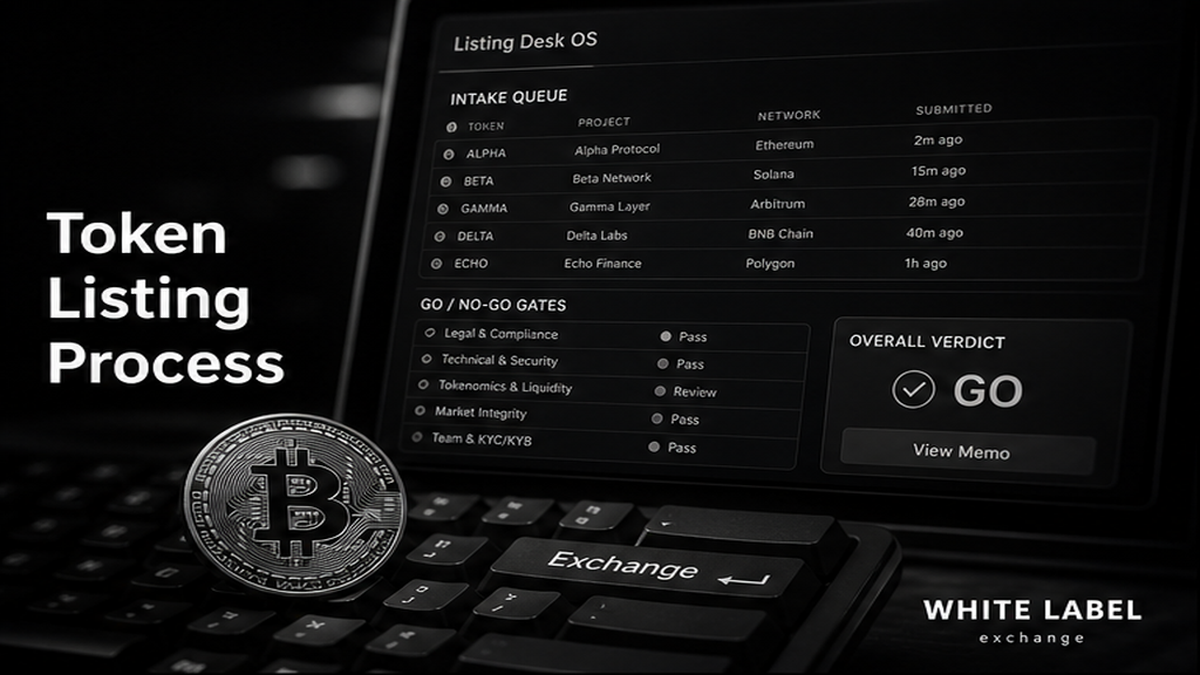
Ad-hoc token listings blow up as client disputes, thin-book incidents, and awkward regulatory questions. A repeatable crypto exchange token listing process fixes that: publish a listing policy with go/no-go criteria, run a standard intake and due-diligence pack, finish wallet and pair integration, then execute listing day and the first 48 hours with written controls. You leave ready to dry-run one listing end to end without spreadsheet chaos.
TL;DR / Quick take: Treat listing as an operator OS, not a BD favour. Publish tiers, restricted assets, and fee rules first. Reject incomplete data rooms early. Score legal, audit, tokenomics, and team KYC before go-live. Wire deposits → trading → withdrawals with MM and risk gates live. Soft-launch 48–72 hours, then keep a delisting playbook current.
Most guides teach projects how to “get listed.” This checklist is for the exchange desk: Listing BD, Compliance, Legal, Wallet Eng, Risk, Market Ops, and Support. Still choosing a launch stack? See how to start a crypto exchange. Also see our compliance checklist for founders. Process guidance only – not legal advice; align with your licence and counsel.
1. Define listing policy: tiers, fees, restricted assets, go/no-go
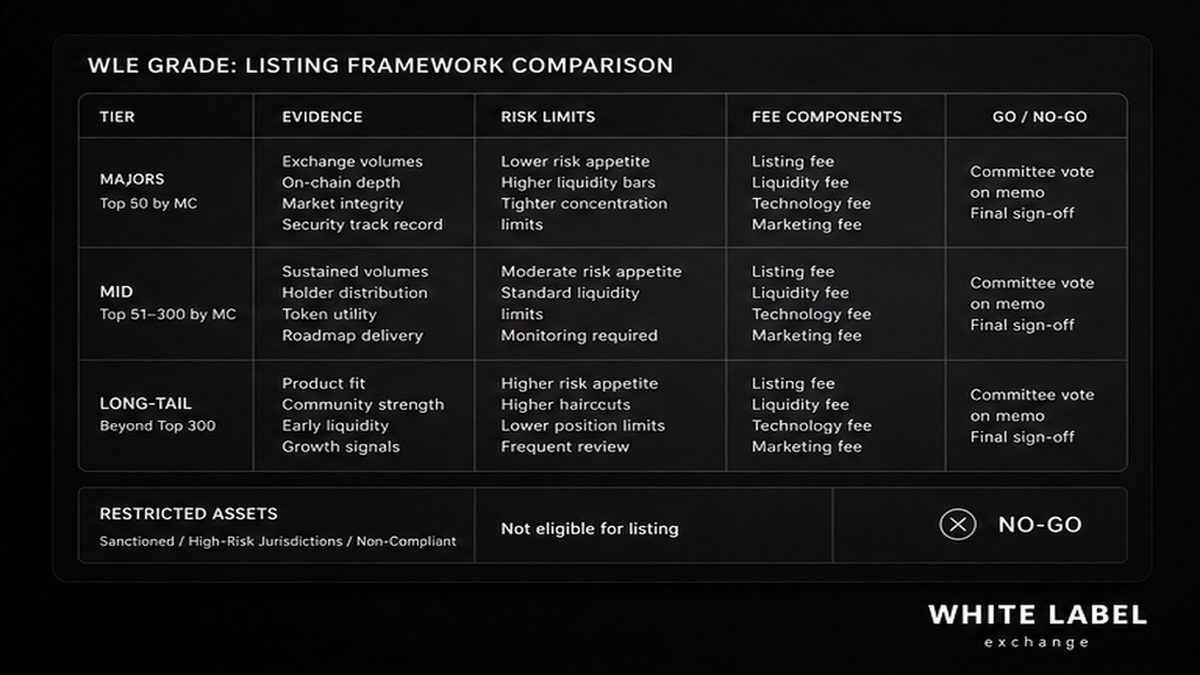
A listing policy is the written rulebook for which assets may trade. Without it, every request is a negotiation. Cover six blocks: scope; listing criteria; procedure; AML/CFT (anti-money-laundering checks); disclosure; delisting plus liability.
- Name asset tiers (majors / mid / long-tail) with different evidence and risk limits.
- List restricted assets: securities without a registration path, mixer-linked tokens, sanctioned-jurisdiction issuers.
- Publish go/no-go criteria – liquidity floor, volatility band, audit freshness, team dox status.
- Separate fee components: cash fee, token allocation, market-maker deposit, campaign budget, legal opinion.
- Assign a listing committee with minutes and a named chair.
Industry practice often uses a liquidity floor around $2–5M combined 24h volume across two or more reputable venues before listing thin books – tune to your size. Tokens that typically move more than about 15% a day need tighter position limits from day one.
Do this: freeze the policy before BD opens a queue. Do not invent fee math per deal – publish components once (see fee structure design).
2. Build the intake pack: application, data room, evidence
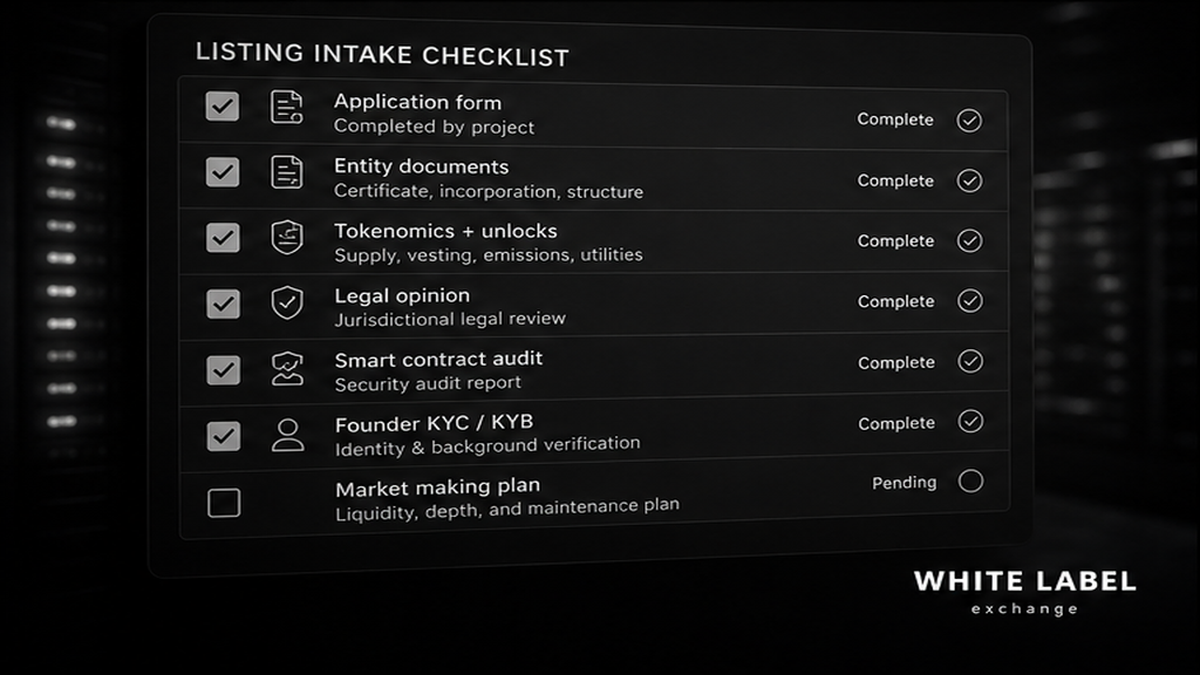
A data room is a closed evidence folder the project must fill before review. Incomplete packs waste hours. Structured checklist review often takes about 3–6 hours; fully loaded cost is sometimes cited near $60–$90/hour, so roughly $200–$550 per vetted listing when the pack is clean.
- Ship one application form – no custom docs per BD lead.
- Require entity docs, whitepaper, tokenomics plus unlock calendar.
- Require a legal opinion on classification and a recent smart-contract audit.
- Collect founder KYC/KYB (ID and company checks), PEP/sanctions screens, MM/liquidity plan, AML policies.
- Reject incomplete rooms at intake with a written reason.
Useful hygiene: applications should come from the core team, not paid intermediaries. Industry reports put all-in project budgets roughly $20k–$75k (small) to $500k–$2M+ (top tier) including fees, MM, audit, legal, and promo.
Do this: publish an intake SLA (projects often prepare 3–6 months). Do not accept undoxxed teams or marketing that contradicts the data room.
3. Run due diligence: audit, legal, tokenomics, team KYC
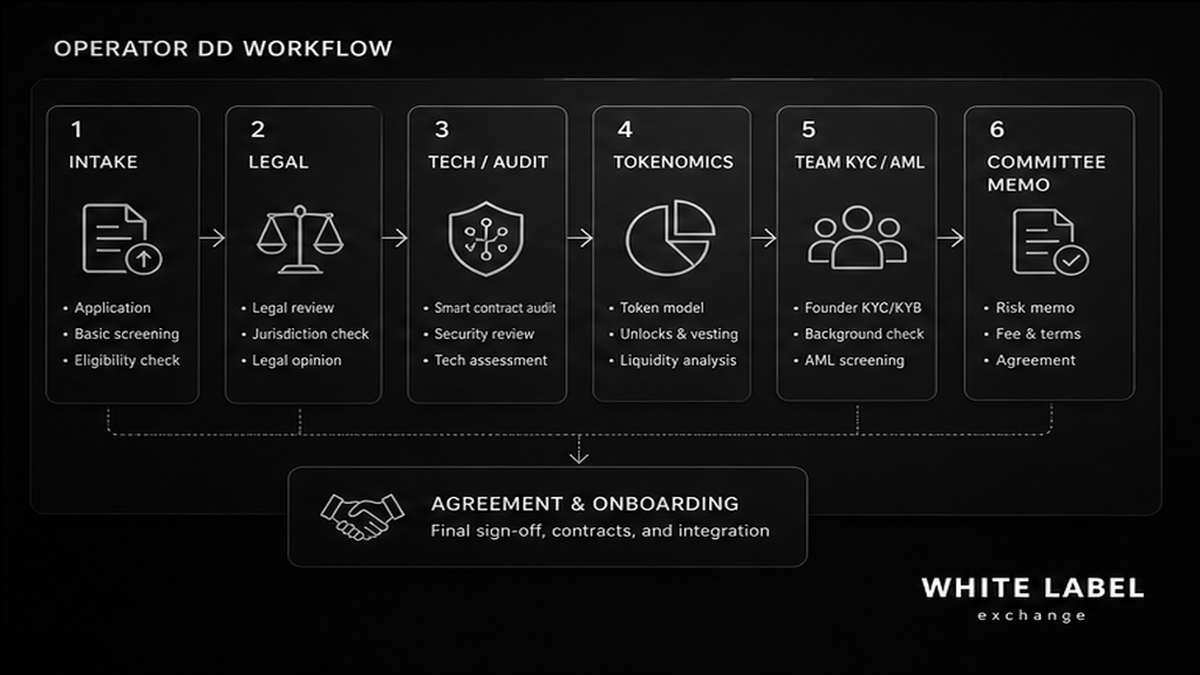
Due diligence (DD) means checking the project like a risk underwriter. Score each gate, write reject reasons, keep an audit trail.
| Stage | Owner | Exit criteria |
|---|---|---|
| Intake | Listing BD | Data room 100% vs checklist |
| Legal | Legal / Compliance | Documented classification; counsel if ambiguous |
| Tech / audit | Security | Critical/high closed; audit not stale |
| Tokenomics | Risk | Unlocks and concentration within policy |
| Team KYC/AML | Compliance | Beneficial owners verified; sanctions clear |
| Decision | Listing committee | Signed memo + listing agreement/SLA |
- Score legal transparency – opinion present; disputes disclosed.
- Review contract security – higher-risk assets often need two independent audits; audits older than ~12 months or post-upgrade without re-audit are commonly rejected.
- Stress tokenomics – circulating supply vs unlock dumps; team wallets; on-chain treasury. Run founder KYC; anonymous teams fail.
- Layer AML: onboarding, on-chain analytics, Travel Rule where required.
- Issue committee memo → agreement with fee transparency, pause rights, indemnities, delisting triggers. No go-live without commercial + compliance sign-off.
Do this: document every reject reason. Do not rush new-chain assets under BD pressure when highs remain open.
4. Complete technical integration: deposits, confirmations, pairs, monitoring
Technical integration wires the token into wallets, deposit rules, pairs, and alerts. Fee-on-transfer, rebasing, or blacklist logic needs custom wallet handling before go-live.
- Confirm chain and token standard; assign eng ownership for non-standard logic.
- Configure deposit addresses and memos; set confirmation counts per chain (often ~12 Ethereum-class / ~15 BNB Chain – use your tested values).
- Size custody: cold often ~90–95% of user assets; hot wallets for about one day of withdrawals (~3–5%) with hard spend limits.
- Test real small deposits and withdrawals – below-min, zero-conf, hot-wallet shortfall.
- Configure pairs, tick size, price bands; wire monitoring before announce.
Operator workflow:
Policy → Intake + data room → DD → Committee + agreement → Tech integration → MM + risk gates → Listing day (deposits → trading → withdrawals) → First-48h + delisting.
In-house listing tooling often takes 6–10 weeks; on a white-label stack the same workflow can be days of configuration. Need matching, wallets, and risk templates? Explore White Label Exchange solutions.
Do this: pass wallet dry-runs before marketing the ticker. Do not open trading on untested deposit/withdrawal paths.
5. Listing-day checklist: MM gates, comms, first-48h controls
Listing day is a controlled go-live. Market makers (MMs) keep buy and sell quotes so traders can enter and exit. Require an MM KPI sheet before announce: spread, depth at ±1%/±2%, quote uptime, inventory limits – not volume alone. Industry benchmarks sometimes cited (not official SLAs): mid-tier near 2.5% / $10k depth / 90% uptime; top-tier nearer 1.0% / $50k / 98%.
- Pass liquidity and risk gates – MM live; position limits; circuit breakers.
- Announce with a calendar – Support macros ready.
- Open deposits first with confirmations defined.
- Open trading next with MM and risk overlays live.
- Open withdrawals last once monitoring confidence is high – pause playbook ready.
- Soft-launch 48–72 hours with reduced limits.
- Watch the first 48 hours for fills, slippage, abnormal flows, unlock dumps; pause if flags trip.
- Keep delisting triggers current – criteria breach, manipulation, security issues, regulatory order, mass complaints – plus notice, remediation, and support path.
Staged launch sequence:
Deposits → Trading (pairs, tick, MM live) → Withdrawals (often gated on monitoring confidence) → Pause playbook ready.
Pair liquidity ops with how to add liquidity to a new crypto exchange.
Do this: run a tabletop pause drill before the first public listing. Do not open all three rails at once without monitoring confidence.
What to do next
Publish the listing policy, freeze the intake checklist, score one dry-run through DD, complete wallet/pair tests, then soft-launch with MM and risk gates. More: White Label Exchange blog. Configure listing workflows via whitelabelexchange.io.
Reviewed by: White Label Exchange Editorial.
Data integrity: ranges cite Spencer Logic, COREDO, CryptoSlate, Codono, and industry fee/MM reports as practice benchmarks, not guarantees or official SLAs. RU Wordstat proxies checked 2026-07-23 (seed “листинг на бирже” 974); English primary volumes were not invented. Not legal advice.
Frequently asked questions
What documents do projects need for a CEX listing?
Require an entity pack, whitepaper plus tokenomics with unlock calendar, legal opinion, recent smart-contract audit with critical/high findings closed, founder KYC/KYB, MM plan, and AML policies. Fail incomplete data rooms at intake.
How much does a crypto exchange listing cost?
Industry reports put all-in budgets roughly $20k–$75k (small) to $500k–$2M+ (top tier), including fees, MM, audit, legal, and promo – not a single “listing fee.” Disclose fee components separately.
When should an exchange reject a token listing?
Reject when the team is undoxxed; critical audit findings remain open; securities classification has no registration path; sanctions/PEP screens fail; liquidity sits below your floor; unlock risk is concentrated with no MM; or marketing contradicts disclosures.
Do we need a lawyer for every token?
Not always external counsel per asset – but every listing needs a documented classification review against your jurisdiction. Escalate ambiguous or mid-tier+ cases to counsel.
What is a safe listing-day order of operations?
Open deposits first, then trading with MM and risk limits live, then withdrawals once monitoring confidence is high. Prefer a 48–72 hour soft launch with a written pause playbook.
How long should operator review take?
With a template checklist, many listings need only about 3–6 hours of review before soft launch. Complex or new-chain assets take longer – do not rush them under BD pressure when the pack is incomplete.