How to Choose a Crypto Exchanger Aggregator (Comparison Framework)
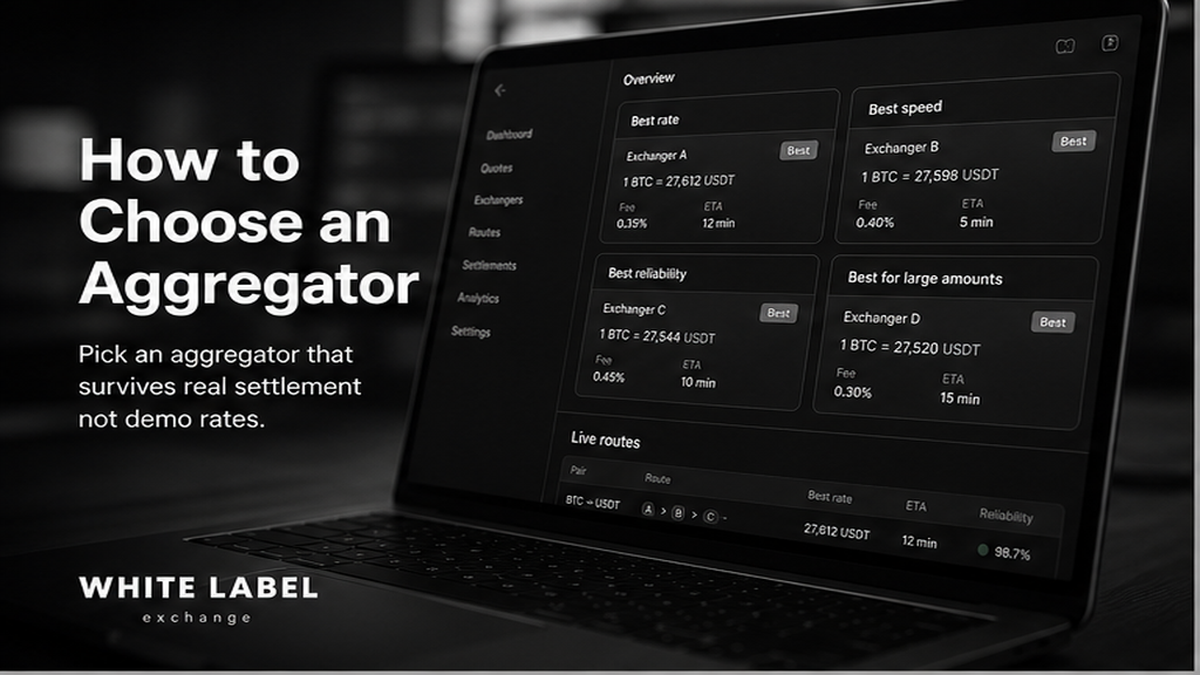
Picking a crypto exchanger aggregator by “best of 2026” lists usually fails founders. An aggregator is a comparison layer that shows rates, limits, and conditions from many exchangers or swap partners so the user finishes the trade in one chosen place. Use this framework to name your model, score rates/uptime/KYC/settlement, pick build vs white-label vs partner API, fill a risk table, and lock a go/no-go checklist before you sign.
TL;DR / Quick insight: Separate rate-board aggregators (Model A), instant-swap partners (Model B), and DEX routers (Model C) before you shortlist. Score effective rate, quote freshness, KYC clarity, and settlement speed. Most MVPs should list on rate boards and/or embed a partner API – build a meta-aggregator only if aggregation is the product. Pilot one corridor, then expand.
English SERP results mostly crown retail swap UIs or on-chain DEX routers. Operators need a different job: decide how aggregators feed traffic and liquidity into a branded exchanger. Plain terms: liquidity means enough inventory to fill the order; KYC is identity checks; white-label is ready-made software you rebrand. Not investment advice and not a “best aggregator” ranking.
1. Clarify what an exchanger aggregator actually does
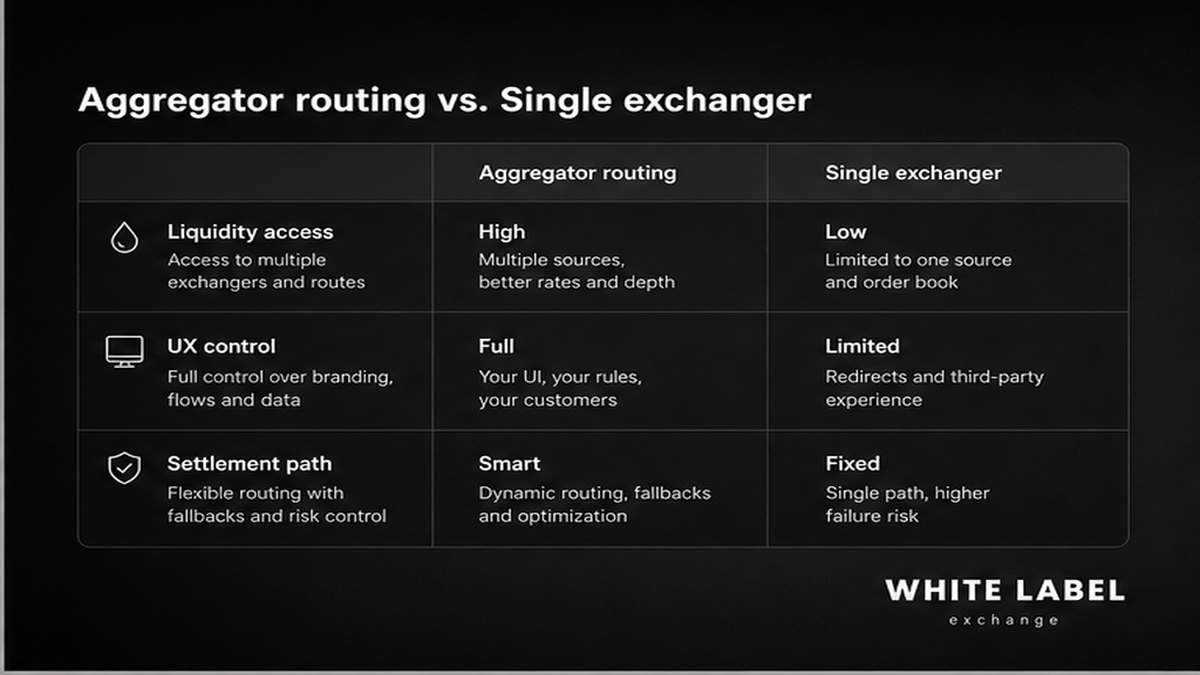
Think of an aggregator like a flight-comparison site: it shows options, then the user books with one airline. Common flow: enter pair and amount → request partner quotes → see rates, fees, and estimated times ranked. Non-custodial models do not hold user funds; the user pays the selected partner. Manual checks can take ~10–15 minutes; aggregator quotes often return in under ~10 seconds (vendor/media claims, April 2026).
| Model | What it is | Founder implication |
|---|---|---|
| A. Rate-board | Compares exchangers’ rates, reserves, reviews; trade completes on the exchanger site | You may list your exchanger (rate export, reputation, reserves) |
| B. Instant-swap | Quotes multiple non-custodial swap partners in one UI; routes to a partner | You may partner via API/widget as a liquidity surface |
| C. DEX aggregator | On-chain routing across pools via smart contracts and a Web3 wallet | Different stack (contracts, gas, MEV) – usually out of scope for a classic exchanger |
Rate-board platforms (BestChange-style) are information layers: rates, fees, limits, reserves – they do not store funds or execute the exchange. BeInCrypto (April 2026) reported ~1M+ rates, 45,000+ pairs, ~470 verified services – media snapshots that drift. Listing usually needs an Exchange Rate Export File (EREF): XML on your site that monitoring polls; updating once per minute is often called insufficient.
Recommendation: Write one sentence of intent: Model A listing, Model B embedded swaps, Model C DeFi routing, or hybrid. Do disambiguate early. Don’t buy a DEX router when you need a rate-board listing path.
2. Score criteria: rates, uptime, KYC depth, settlement speed
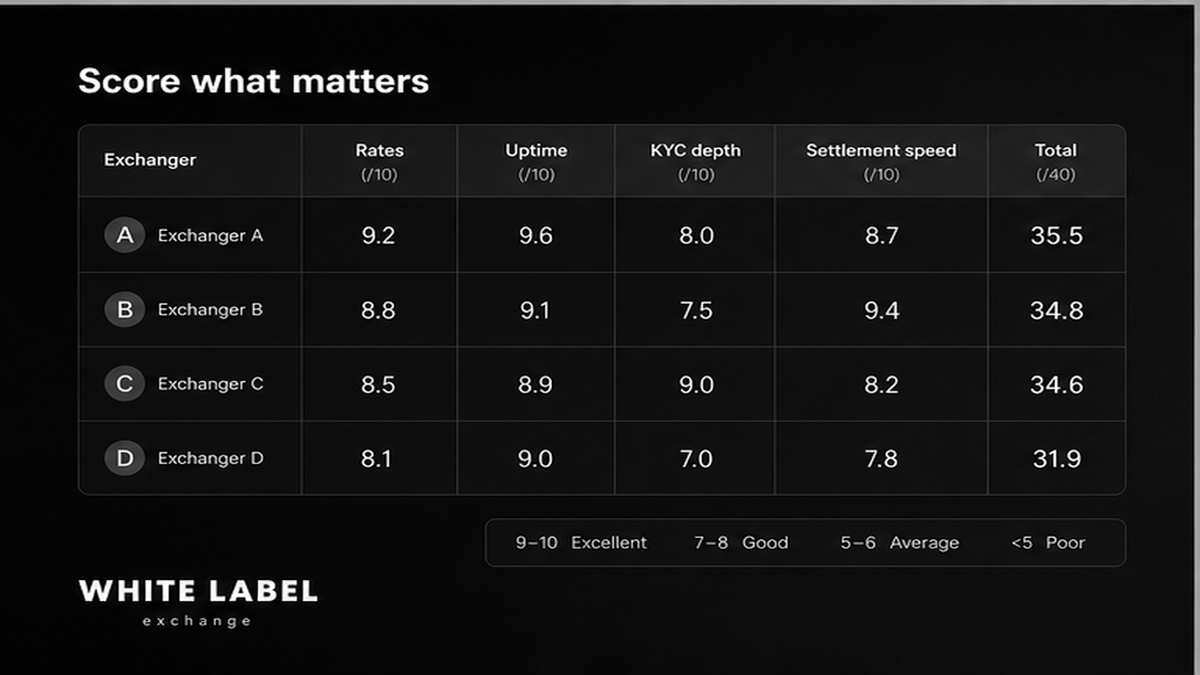
Retail blogs list partner count and “fee transparency.” Founders need four axes scored 1–5 after a real test order.
| Criterion | What to measure | Red flags |
|---|---|---|
| Rates | Effective receive amount after all fees vs mid-market | Hidden fees; bait rates that vanish at confirm |
| Uptime | Quote freshness; export poll SLA; outage history | Stale XML; frequent “rate changed” cancels |
| KYC depth | When ID is required; who collects data; jurisdiction fit | Opaque verifying flags; KYC mid-flow with no policy page |
| Settlement | Median/slow completion; stuck-order process | No swap ID; no escalation path |
Rate spreads for the same pair are often cited around ~1–3% in normal conditions and higher when liquidity is thin (illustrative media range). Partner processing commonly lands ~2 to 30+ minutes. Aggregators often monetize via partner commissions – ask where the margin sits. Do run the same corridor on two shortlists and log receive amount, time, and KYC triggers. Don’t pick partner count without a mystery-shop order. More on inventory: what crypto liquidity means for operators.
3. Choose build vs white-label vs partner API
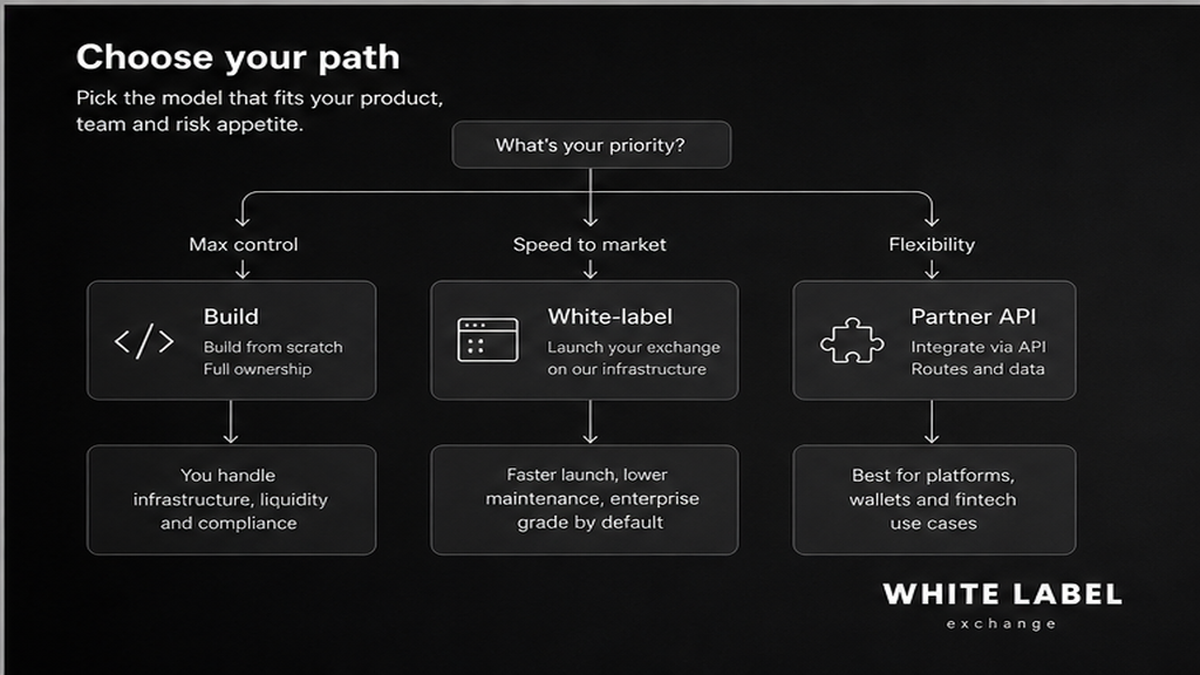
| Path | Best when | Trade-offs |
|---|---|---|
| Build custom aggregator | Aggregation is the product | Longest timeline; custody if you touch funds; QC across many partners |
| White-label + listing export | Branded exchanger needing monitoring traffic | Must keep reserves, reputation, fresh EREF; follow listing rules |
| Partner API / widget | In-app swaps without full inventory | Margin share; brand dilution; partner KYC/rail dependency |
White-label stacks often market liquidity aggregation and LP APIs as launch modules (vendor positioning, not a price quote). Partner widgets let wallets embed swap without a full exchange. Vendors also sell rate-export automation and listing prep – vendor-reported offerings, not endorsements. Do document ownership, SLAs, and custody in the contract. Don’t assume “API integration” skips compliance pages – boards still expect honest KYC/manual flags.
Verdict: For rate-board traffic, prefer white-label plus export automation over a custom meta-aggregator. For in-app swaps only, embed a partner API first. Review a ready stack on White Label Exchange when build timelines block launch – still validate who holds funds and who maintains the export. See also white-label crypto exchange basics.
4. Map risks: chargebacks, frozen rails, fake liquidity
Quality control is hard with hundreds of listed exchangers. Platforms tighten onboarding against fake rates and review manipulation. Users should still verify the destination – execution happens off the aggregator.
| Risk | Symptom | Mitigation |
|---|---|---|
| Fake / thin liquidity | Great rate; reserve 0 or fails at amount | Cap to verified reserves; monitor export; mystery-shop |
| Frozen rails | Bank/e-money methods stop mid-week | Multi-rail fallback; pause direction in export |
| Chargebacks | Fiat in, crypto out, then reversal | Clear terms; evidence retention; lawful delay-release |
| Listing ban | Delist after policy breach | Compliance pages; honest verifying/manual params |
| Settlement stalls | Funds stuck beyond ETA | Support runbook; tx-hash checks; reserve buffer |
Do treat advertised rate and real reserve as two fields. Don’t chase top-of-board placement with rates you cannot fill.
Workflow: Corridor map → scorecard (1–5) → path (build / white-label / API) → risk table → small pilot → go/no-go
5. Complete the founder decision checklist
- Name the job-to-be-done in one sentence: Model A, B, C, or hybrid.
- Map your top 5–10 corridors and where users already discover rates.
- Score each shortlist on rates, uptime, KYC depth, and settlement (1–5 each).
- Choose delivery path; write who owns brand, funds, SLAs, and support escalation.
- Fill the risk table for fake liquidity, frozen rails, chargebacks, bans, and stalls.
- Pilot one or two corridors; verify export freshness, reserves, dispute path, policy pages.
- Lock go/no-go: legal review, export/API ready, ops runbooks – then expand pairs and ads.
Do keep a paper trail of test orders. Don’t scale until the export stays fresh under monitoring polls and reserves match ads.
What to do next
- Write the one-sentence model choice into your product brief.
- Fill the four-axis scorecard for two options with real test amounts.
- Draft the risk table with an owner per row.
- Decide build vs white-label vs partner API with a pilot go-live date.
- Schedule legal and ops review before listing fees or production API keys.
Need a branded stack with rate-export readiness? Start at whitelabelexchange.io or browse guides on the White Label Exchange blog.
Material reviewed: White Label Exchange Editorial.
Data note: Flows, spreads, processing times, and platform stats attributed to media and operator docs in research notes as of 16 July 2026 (The Coin Republic, BeInCrypto, VentureBeat, BestChange docs/wiki). Wordstat volumes unavailable; no fabricated counts. Media/vendor figures are snapshots, not WLE pricing. Not legal or investment advice.
Frequently asked questions
What is a crypto exchanger aggregator?
A comparison layer that shows rates, limits, and conditions from multiple exchangers or swap partners so the user picks one place to complete the trade. In non-custodial setups it does not hold funds.
How is an aggregator different from a single exchanger?
A single exchanger shows only its own book. An aggregator surfaces many offers. Operators still win by filling what they advertise – on Model A the board does not settle the trade for you.
How do you evaluate aggregator APIs?
Test quote accuracy vs final receive amount, fail rates, KYC triggers, settlement SLAs, sandbox docs, and who holds funds. Log results in the same 1–5 scorecard you use for rate boards.
DEX aggregator or exchange aggregator – which do you need?
DEX aggregators route across on-chain pools with a Web3 wallet. Exchange/exchanger aggregators are off-chain instant partners or rate-board listings. Pick by asset type and custody – do not treat DEX routers as listing traffic.
Do you need to build your own aggregator?
Usually no at MVP. List on rate boards and/or embed a partner API. Build a custom meta-aggregator only if aggregation is the product and you can staff partner quality control.
What breaks rate-board listings?
Stale rates, mismatched reserves, review fraud, missing AML/KYC policy pages, or ignoring export rules (refresh cadence and honest verifying/manual flags).
Where does white-label software fit?
It speeds up a branded exchanger with wallets, admin, and rate-export automation so you can compete for aggregator traffic without a full custom stack. Still validate custody, SLAs, and compliance ownership before launch.