Crypto Payment Gateway Launch Checklist for Operators
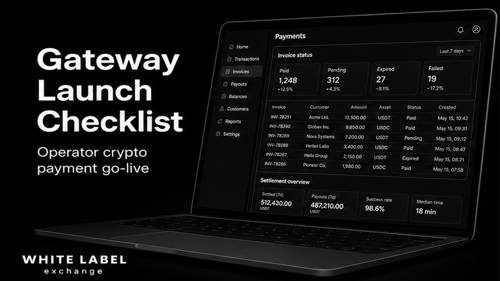
Merchant demos look fine until the first underpaid invoice, stuck webhook, or bank that never approved crypto settlement in writing. A crypto payment gateway creates payment requests and tracks chain events until funds settle – often with a processor that confirms, converts, and pays out. Use this checklist to map use cases, pick build vs white-label vs processor, lock KYC/AML and disputes, wire invoice states, then run a 30-day go-live.
Summary: Freeze use cases, assets, and settlement rails before demos. Choose build, white-label crypto payment gateway, or hosted processor via a custody/fee/control table. Lock KYB, sanctions screening, Travel Rule on payouts, and underpay/refund runbooks. Wire idempotent webhooks and invoice states into ledger recon. Soft-launch 30 days with limits and exit KPIs before raising volume.
SERP pages push “best crypto payment gateway 2026” lists for merchants. Operators need a printable launch sequence. Plain terms: KYB is know-your-business on the merchant; a webhook is an automated status ping; reconciliation matches chain deposits to invoices and your ledger. Not legal advice. Broader stack: crypto exchange compliance checklist for founders.
Map merchant use cases, assets, and settlement rails before vendor demos
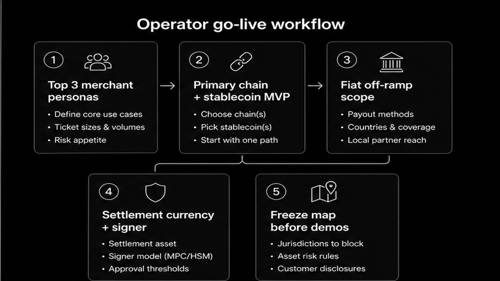
Start with a one-page use-case map, not a sales feature matrix. Write who pays whom, in which asset, and how the merchant gets paid out. B2B invoices, ecommerce checkout, and mass payouts fail differently – do not force one product story.
- Flow: invoice, checkout, or payout
- Assets: stablecoin-first vs multi-asset (start narrow)
- Settlement: crypto-in / crypto-out vs fiat off-ramp
- Jurisdiction of merchant, payer, and bank or LP
- Custody: who holds keys during pending confirmations
- List the top three merchant personas for the first 90 days.
- Pick one primary chain and one stablecoin for MVP unless a corridor forces more.
- Mark fiat off-ramp as required, optional, or out of scope for v1.
- Name the settlement currency and who signs bank/LP terms.
- Freeze the map before vendor demos or custom SOWs.
In practice: Build guides often start with one chain plus one stablecoin, then pilot 3-5 merchants. That still fails if banks never permit crypto flows in writing.
Compare build vs white-label vs processor models
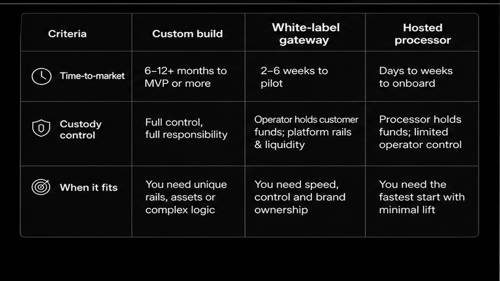
Decide who owns the stack before comparing fee pages. The gateway is the checkout / payment-request front; the processor confirms, converts, and settles. Many vendors bundle both. Choose custom build, white-label crypto payment gateway under your brand, or a hosted processor you embed.
| Criteria | Custom build | White-label gateway | Hosted processor |
|---|---|---|---|
| Time-to-market | Months; eng + compliance | Weeks if stack is ready | Days to weeks |
| Custody control | You design wallets | Contract who holds keys | Usually vendor custody |
| When it fits | Unique rails, deep eng | Operator brand + speed | Fast test, less control |
Headline % is not total cost – add network, conversion, withdrawal, and exception fees. Sanity checks (verify live): NOWPayments 0.5%; Coinbase Commerce 1%; BitPay tiers often cited around 2%+25¢ to 1%+25¢; BTCPay self-hosted at 0% third-party fee.
| Criteria | Hosted SaaS | Self-hosted (e.g. BTCPay) | White-label stack |
|---|---|---|---|
| Processing fee | Vendor % (verify live) | 0% third-party fee | Platform fee in contract |
| Ops burden | Lower infra, vendor SLAs | You run nodes and uptime | You run merchant ops |
| Compliance hooks | Ask what you configure | You wire KYB / screening | Demand audit logs in SOW |
Exchange-scale build vs white-label: white label vs build a crypto exchange. Turnkey infrastructure under your brand is the lane of White Label Exchange – still diligence custody, Monitoring Services, and payment hooks in the contract.
Recommendation: Default to white-label or hosted processor until the use-case map proves a custom rail is required.
Lock KYC/AML, Travel Rule touchpoints, and dispute playbooks
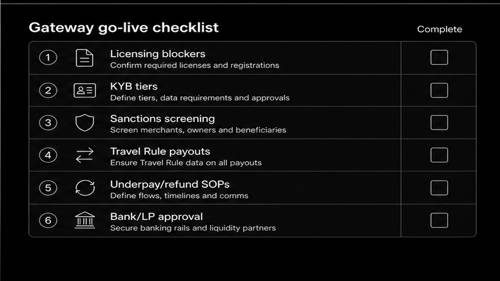
Compliance is a go-live gate. If you custody, exchange, or transmit virtual assets or fiat for others, expect a licensing perimeter (VASP / CASP / MSB / money-transmitter rules vary). EU MiCA CASP is not EMI/PI under PSD2. US activity often maps to FinCEN MSB plus state money-transmitter exposure – confirm with counsel.
- Merchant KYB and ongoing monitoring
- Sanctions and on-chain screening on deposits and payouts
- Travel Rule readiness for qualifying VASP-to-VASP payouts
- Written dispute / refund / chargeback-analogue playbooks
- Bank or LP due diligence with crypto permission in writing
Travel Rule (FATF R.16): qualifying VASP-to-VASP moves need originator and beneficiary data. Baselines: FATF often USD/EUR 1,000; US FinCEN commonly $3,000; EU TFR with no practical de minimis for CASP crypto transfers. Do not hardcode one threshold. Deep wiring: crypto Travel Rule compliance checklist.
No classic card chargeback, but merchants still need underpay, overpay, late pay after expiry, double-pay, refund, and contested-delivery runbooks. Name who freezes settlement.
- Name the licensing question that would block go-live per corridor.
- Approve KYB tiers and refresh cadence for merchants.
- Attach sanctions/on-chain screening to confirm and payout release.
- Mark which payouts trigger Travel Rule messaging.
- Publish underpay / overpay / expired / refund / dispute SOPs.
- Require written bank/LP approval for crypto settlement rails.
Important: Software is not a license. Module selection: AML software modules guide; founders still need the compliance checklist above.
Wire webhooks, invoice states, and reconciliation into ops
If invoice states live only in a vendor dashboard, you rent a UI. Define a state machine ops can read: new, pending, underpaid, overpaid, expired, confirmed, settled, failed. Edge cases: underpay, late pay after expiry, double-pay, node outage mid-confirmation.
- Document the state diagram and merchant-visible copy per state.
- Require idempotent webhooks so duplicates never double-credit.
- Store provider event IDs next to internal invoice IDs.
- Reconcile chain deposits to invoices and the ledger daily.
- Alert on stuck pending, webhook fail spikes, and recon breaks.
- Sandbox underpay, overpay, expiry, and double-pay before pilot.
Popular mistake: One global confirmation count for every asset. Calibrate on real volume; high-value invoices often need stricter rules than micro checkout.
Run a 30-day go-live checklist: sandbox, limits, monitoring, exit criteria
Soft-launch beats a big-bang press release. Controlled beta guidance often uses about 30 days of elevated monitoring, then progressive capacity after a clean beta – ops practice, not a guarantee.
Before public volume
- Use-case map and model choice signed by product, compliance, ops
- Sandbox e2e including compliance tests and unhappy invoice paths
- Written bank/LP approval for settlement rails
- Pilot merchants (often 3-5) with volume and velocity limits
- On-call for webhook failures and recon breaks
First 30 days KPIs (exit criteria)
- Confirmation lag within agreed SLA per asset
- Webhook fail rate below your internal threshold
- Reconciliation breaks closed same day
- Manual review queue age under the ops cap
- No open bank/LP settlement blockers
Raise limits only after exit criteria pass. What next: freeze the map, pick the model, ship compliance and dispute packs, wire invoice/webhook/recon, soft-launch 30 days. For branded exchange infrastructure with monitoring-oriented ops, review White Label Exchange and the blog.
Material verified: White Label Exchange Editorial.
Data reliability: Model definitions, PSP go-live pillars, fee examples (NOWPayments, Coinbase Commerce, BitPay, BTCPay), and Travel Rule baselines checked vs research sources as of August 2026. Ahrefs (US) for keywords. Not legal advice.
Frequently asked questions
What is a crypto payment gateway?
The front-end layer that creates invoices or payment requests and tracks on-chain events until settlement. Many products also include a processor for confirmation, conversion, and payout. Write which layers you own before buying.
Crypto payment gateway vs payment processor?
Gateway = checkout and payment-request UX. Processor = confirm, convert, settle, and often compliance rails. Ask which layers the vendor operates and who holds custody while payments are pending.
Do I need a license for a crypto payment gateway?
Usually yes if you custody, exchange, or transmit virtual assets or fiat for others. Map each corridor (VASP, CASP, MSB, money-transmitter). Not legal advice – confirm with counsel.
What is a white-label crypto payment gateway?
A pre-built stack you brand and operate. You still own merchant KYB, policies, dispute playbooks, and go-live ops. Compare it to a hosted processor when you need brand control without a full custom build.
How to build or create a crypto payment gateway?
Treat “build” as a model decision, not a default. Finish the use-case map and licensing path first. If you still custom-build, start with one chain and one stablecoin, then pilot a few merchants.
Self-hosted vs custodial gateway?
Self-hosted stacks like BTCPay charge 0% third-party fees and send funds to your wallet, but you run infra and compliance. Custodial hosted processors trade control for speed – document who holds keys.
How to set up a crypto payment gateway safely?
Sandbox e2e, written bank/LP approval, pilot merchants with volume limits, then 30-day monitoring on confirmation lag, webhook failures, and recon breaks. Raise limits only after exit criteria pass.