How to Handle Customer Disputes Efficiently

Picture this: A user logs into your crypto exchange, frantic. They claim a recent transaction wasn’t authorized, or perhaps the cryptocurrency they purchased never arrived. Your support team is already overwhelmed, and the user is threatening a chargeback through their bank. This scenario is a nightmare for any exchange operator, but it’s also an inevitable part of running a platform where digital assets and traditional finance intersect.
Handling customer disputes efficiently isn’t just about resolving individual tickets—it’s about protecting your revenue, maintaining regulatory compliance, and building the trust that keeps users coming back. For a whitelabel crypto exchange, where you might be handling operations for multiple partners, a robust dispute management system is even more critical. The challenge is unique because crypto transactions, once confirmed on the blockchain, are irreversible by design. This fundamental characteristic of “transaction finality” means that traditional chargeback mechanisms don’t apply in the same way they do with credit cards. So, how do you navigate this landscape effectively?
The Unique Anatomy of Crypto Exchange Disputes
Before diving into solutions, it’s essential to understand why disputes on crypto exchanges are particularly complex:
- The Chargeback Paradox: This is the core issue. When a customer buys cryptocurrency with a credit card, they receive the digital asset instantly and can transfer it off the exchange. If they later file a chargeback with their card issuer (claiming the purchase was unauthorized), the exchange is left in a double-loss position: they lose both the cryptocurrency and the fiat payment. This is a high-risk area, especially for new or smaller exchanges.
- Irreversible Transactions: Unlike traditional banking, where transactions can be reversed during a dispute window, confirmed blockchain transactions are permanent. There’s no “undo” button on the Bitcoin network.
- Regulatory Scrutiny: Regulators globally, under frameworks like MiCAR in the EU, expect crypto firms to have robust, defensible compliance and customer protection mechanisms. Failure to handle disputes properly can lead to enforcement actions, fines, and reputational damage.
- Sophisticated Fraud: Fraudsters exploit the chargeback window and the finality of crypto transactions, using stolen credit cards to purchase crypto before initiating disputes.
Proactive Prevention: The Best Defense is a Good Offense
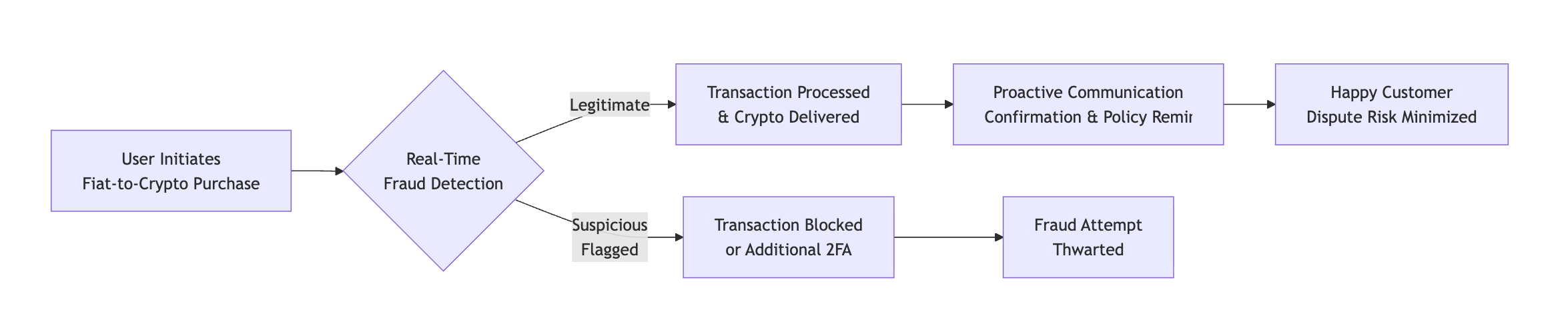
The most efficient way to handle a dispute is to prevent it from happening in the first place. A layered, proactive strategy is non-negotiable for high-risk operations like crypto exchanges.
The case study of a crypto exchange that implemented this approach speaks volumes. By integrating near real-time fraud detection, using customizable rules to block high-risk transactions, and leveraging multi-card network support, they achieved an 80% reduction in credit card chargebacks related to crypto purchases, securing $500,000 in annual revenue and boosting transaction volumes by 30%.
Key Prevention Strategies for Your Exchange
| Strategy | How It Works | Why It’s Critical for Crypto Exchanges |
| Advanced Fraud Detection | AI-driven tools analyze patterns, device IDs, and transaction velocity in real-time to flag suspicious activity. | Stops fraudulent purchases before crypto is delivered, preventing the double-loss scenario. |
| Strong Authentication (2FA/3DS) | Implements two-factor authentication and 3D Secure for card transactions. | Adds a critical layer of security, reducing “unauthorized transaction” claims from genuine users. |
| Transparent Policies | Clearly displays refund, cancellation, and transaction policies at checkout and in confirmation emails. | Sets clear expectations, reducing confusion-based disputes and providing evidence if a chargeback occurs. |
| Proactive Communication | Sends immediate purchase confirmations, delivery receipts, and renewal reminders. | Keeps the user informed, making them less likely to panic and file a dispute. Provides a paper trail. |
| Clear Billing Descriptors | Uses a recognizable name and contact info on bank statements (e.g., “YOUR EXCHANGE – Support: …”). | Prevents “I don’t recognize this charge” disputes, which are a common source of friendly fraud. |
Effective Resolution: When Disputes Do Happen
Even with perfect prevention, disputes will arise. Your resolution process must be swift, fair, and compliant. Here’s a structured approach:
1. Intake & Triage
When a dispute is received (whether via support ticket or a formal chargeback alert), log it immediately and categorize it by type (e.g., unauthorized transaction, non-delivery of crypto, technical error). Time is of the essence, especially for chargebacks which have strict response deadlines.
2. Investigation & Evidence Gathering
This is where your proactive measures pay off. Automatically gather all relevant evidence:
- Transaction Logs: On-chain transaction IDs with timestamps.
- User Activity: Login history, IP addresses, device information.
- Communication Records: Copies of all emails and support chats.
- KYC/AML Data: Verification records to confirm the user’s identity.
- Policy Acknowledgment: Proof that the user agreed to your terms of service.
3. Resolution & Response
For internal disputes, your support team can investigate and resolve directly. For formal chargebacks, you must compile the evidence into a compelling “representment” package to fight the claim with the card issuer or bank. Automation is key here. Platforms like Justt specialize in automating evidence compilation for crypto disputes, significantly increasing win rates and recovering revenue.
4. The Role of Arbitration for Complex Disputes
For high-value or technically complex disputes (e.g., involving smart contracts, coding errors, or hack-related losses), traditional arbitration is becoming a valuable tool. Arbitration provides a neutral, legally binding forum where specialized arbitrators can understand the technical nuances of blockchain and crypto. Firms like JAMS offer protocols specifically for blockchain disputes, and experts like Steven Skulnik have extensive experience arbitrating cryptocurrency and digital asset matters. This path offers finality and avoids unpredictable court litigation.
Building a Resilient Framework: Technology & Compliance
Efficient dispute management isn’t just a support function; it’s a pillar of your overall compliance and technology stack.
- Leverage Automation: Manual dispute handling is unsustainable. Invest in platforms that integrate with your exchange to automate fraud alerts, evidence collection, and even chargeback responses.
- Embrace Blockchain Analytics: Tools that trace the movement of funds on the blockchain are crucial for investigating hacks, verifying transactions, and providing evidence in disputes.
- Align with Regulation: Ensure your dispute process meets the standards expected by regulators like those under MiCAR. This includes maintaining transparent records, conducting regular risk assessments, and having a clear allocation of responsibilities within your team. A culture of accountability, with compliance officers empowered to escalate issues, is essential.
- Consider Multi-Signature Escrow: For high-value peer-to-peer transactions on your platform, consider implementing a 2-of-3 multi-signature wallet setup. The buyer, seller, and a neutral arbitrator (which could be your exchange or a trusted third party) each hold a key. If a dispute arises, the arbitrator can help resolve it by providing the second signature to release funds to the rightful party.
From Cost Center to Trust Builder
Handling customer disputes efficiently is a strategic imperative. Every prevented chargeback is direct revenue protected. Every resolved dispute fairly and transparently is an opportunity to build immense user trust and loyalty—something invaluable in the competitive crypto exchange market.
The most successful exchanges will view their dispute management system not as a reactive cost center, but as a proactive, intelligent shield integrated into their core operations. By combining advanced fraud prevention, clear communication, automated resolution tools, and a commitment to regulatory compliance, your whitelabel exchange can turn the challenge of customer disputes into a demonstration of reliability and professionalism. This not only safeguards your platform but also elevates the entire ecosystem, making digital asset trading safer and more trustworthy for everyone.