White Label Crypto Exchange Cost: The 2026 Guide for Founders
Let’s cut through the noise. If you’re looking into launching your own crypto trading platform, one of the first questions that hits you is: How much does it actually cost? The short answer is that the white label crypto exchange cost has dropped dramatically, making it more accessible than ever to enter the market. The longer, more valuable answer is that understanding the breakdown of these costs is key to making a smart investment and launching successfully.
Back in 2020, getting a functional white label platform off the ground typically required a budget north of $100,000 and a timeline of six months or more. Fast forward to 2026, and the landscape has transformed. Production-ready solutions can now be deployed in as little as 4 to 8 weeks, with initial costs ranging from approximately $15,000 to $60,000. This significant cost compression is a game-changer for startups and entrepreneurs. However, the quoted setup fee is just the tip of the iceberg. Let’s dive into what truly drives the cost to start a crypto exchange and how to navigate the pricing landscape.
Understanding the Pricing Landscape
The white label cryptocurrency exchange cost isn’t a single number. It’s a spectrum influenced by your business model, technical requirements, and the provider you choose. Here’s a clear look at the primary pricing models you’ll encounter:
1. One-Time License Fee (With Source Code)
This model, offered by providers like Codono, involves a single upfront payment. You receive the full source code, which you host on your own servers. This gives you complete control over your data and infrastructure, with no monthly licensing fees or revenue sharing. This path often represents the most cost-effective long-term solution for operators with technical capabilities, as you avoid ongoing subscription costs. Initial costs for this model typically start around $10,000.
2. Subscription-Based / Cloud Hosting
Providers like HollaEx offer a cloud-based model. You pay a recurring monthly or annual fee to use their hosted, maintained software. This approach minimizes your upfront technical burden and IT costs, as the provider handles server management, security updates, and maintenance. The white label crypto exchange pricing here is predictable operational expenditure (OpEx), with plans often starting from a few hundred dollars per month, scaling based on features and volume.
3. Custom Development (Not White Label)
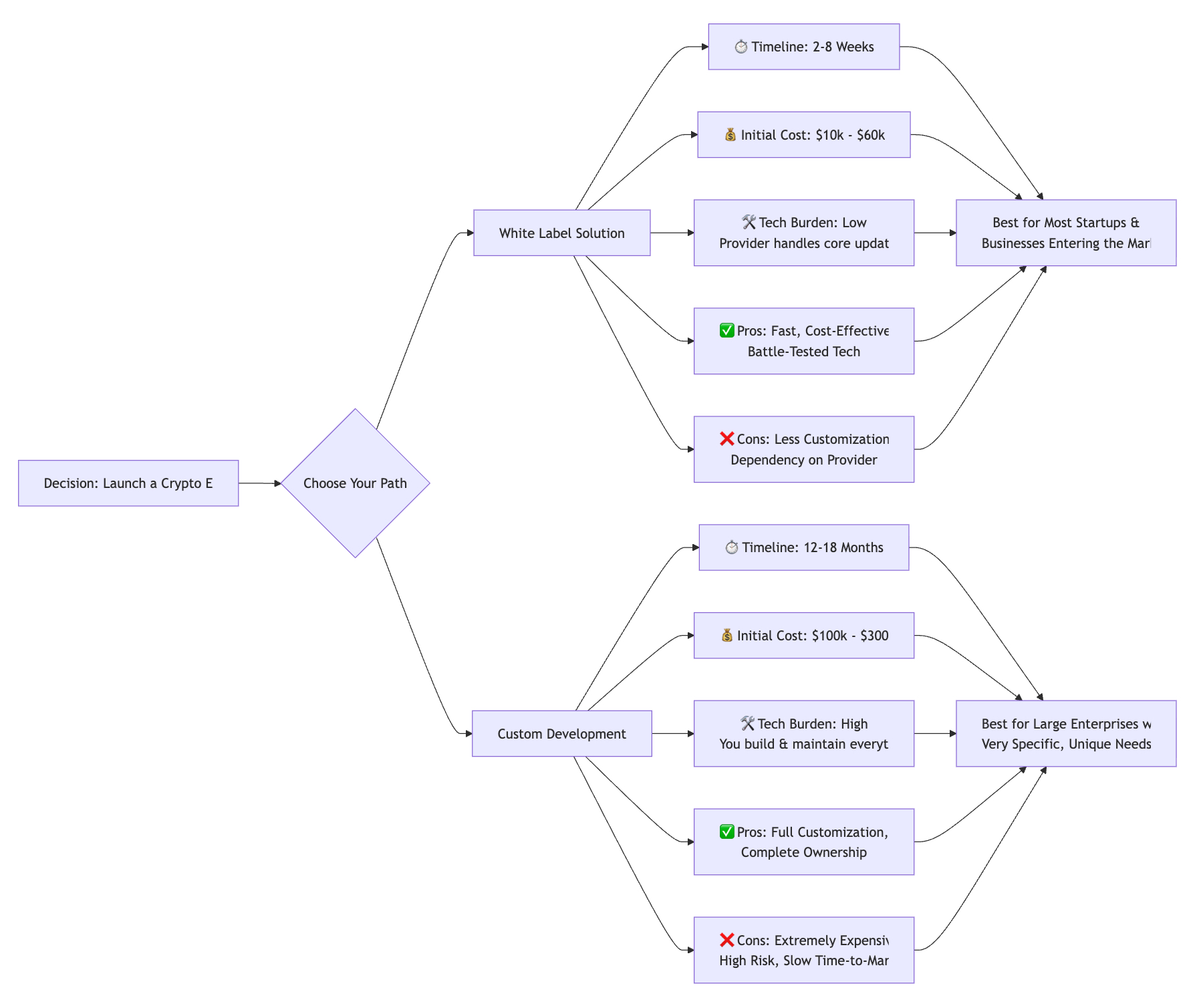
For comparison, building an exchange from scratch is a different beast entirely. The cryptocurrency exchange development cost for a custom solution typically ranges from $100,000 to $300,000+ and can take 12-18 months. This path is only for those with highly unique, non-standard requirements not met by existing white label solutions.
To visualize the fundamental difference, here’s a comparison between the two primary paths for founders:
Key Factors That Influence Your Final Cost
Several critical factors will determine where your project falls on the pricing spectrum. Being clear on these will help you get accurate quotes and plan your budget effectively.
- Feature Set & Trading Types: A basic spot trading exchange is the most affordable starting point. Adding margin trading, futures contracts, or OTC desks significantly increases complexity, requiring more sophisticated risk management systems and liquidity reserves, which drives up the white label exchange pricing.
- Customization & Branding: The extent to which you need to modify the core UI/UX, integrate specific local payment gateways, or add unique features affects cost. A “plug-and-play” setup with your logo is cheapest; deep customizations cost more.
- Regulatory & Compliance Modules: In 2026, compliance isn’t optional. Integrating robust KYC/AML systems that meet standards like MiCA (EU) or FinCEN (US) is essential. The cost and complexity of these modules can vary based on your target jurisdictions.
- Liquidity Setup: A crucial hidden cost. An exchange without liquidity is a ghost town. Many white label providers offer liquidity aggregation services, connecting your order book to larger exchanges and market makers to ensure competitive spreads from day one. This service often comes with its own setup and/or volume-based fees.
- Security Enhancements: While base security is included, advanced features like multi-signature cold wallet management, DDoS protection, and specialized smart contract audits may incur additional costs. Never cut corners here.
The Hidden Costs You Must Plan For
The setup fee is just your capital expenditure (CapEx). To get a true picture of the cost to start crypto exchange operations, you must factor in ongoing operational expenses (OpEx):
- Hosting & Infrastructure: If you own the source code, you pay for cloud servers (AWS, Google Cloud), CDN, and security monitoring.
- Liquidity Provision: Beyond setup, maintaining deep liquidity might require subsidies or market-making agreements.
- Payment Gateway Fees: Costs for processing fiat deposits and withdrawals (credit cards, bank transfers) are typically passed through or shared.
- Compliance & Legal: Ongoing costs for KYC provider subscriptions, legal counsel for regulatory matters, and potential license fees.
- Marketing & User Acquisition: Your biggest ongoing variable cost. Acquiring traders in a competitive market requires significant investment.
Making the Right Choice for Your Business
The evolution of the market means you no longer need a seven-figure budget to test your concept. For the vast majority of founders, a white label solution is the smartest, most capital-efficient path to market.
Strategic Insight: The question has shifted from “Can I afford to build an exchange?” to “Can I afford not to use a white label solution?” The time and cost savings allow you to focus your limited resources on what truly differentiates your business: market positioning, regulatory strategy, user experience, and liquidity development.
Start by clearly defining your minimum viable product (MVP). Do you need spot trading only? What core features are non-negotiable? Use this to get quotes from several reputable providers. Always ask for a breakdown of what’s included in the setup fee versus what incurs additional monthly costs. And critically, inquire about their liquidity solution and compliance module capabilities.
Launching a crypto exchange is a significant venture, but the barrier to entry has never been lower. By understanding the true white label crypto exchange cost structure and planning for both visible and hidden expenses, you can make informed decisions, allocate capital wisely, and set your platform on a path to success in the dynamic digital asset market.
Frequently Asked Questions (FAQ)
How much does a white label crypto exchange cost in total for the first year?
Beyond the initial setup fee of $15,000 – $60,000, plan for an additional $20,000 – $50,000+ in the first year for hosting, liquidity, basic compliance tools, and initial marketing. Your total Year 1 investment could realistically range from $35,000 to $110,000, depending on your choices and scale.
Are there really “free white label crypto exchange” options?
Truly free, production-ready software with no strings attached is rare and often comes with severe limitations (e.g., branding, transaction limits). However, some providers offer open-source starter kits (like HollaEx Kit on GitHub) or very low-cost basic plans. The cost of white label crypto exchange software is typically justified by the support, security updates, and compliance features included.
What’s the cheapest way to start a crypto exchange?
The most affordable path is to choose a one-time license white label solution with a minimal feature set (spot trading only), host it on cost-effective cloud infrastructure, and use a built-in liquidity aggregation service. This approach minimizes both upfront and ongoing costs.
How does white label cost compare to building from scratch?
Building a custom exchange is 5 to 10 times more expensive initially ($100k – $300k+ vs. $15k – $60k) and takes much longer (12-18 months vs. 4-8 weeks). It also requires a large, specialized in-house development and security team, which is an ongoing, high fixed cost.
Does the white label cost include getting a license to operate legally?
No. Software cost and legal/regulatory licensing are separate. The cost to start a crypto exchange includes the technology, but you must independently obtain the necessary financial licenses (e.g., MSB registration in the US, VASP registration in the EU) and pay associated fees, which can be substantial and vary by jurisdiction.