How to Launch a White Label NFT Marketplace: Operator Checklist
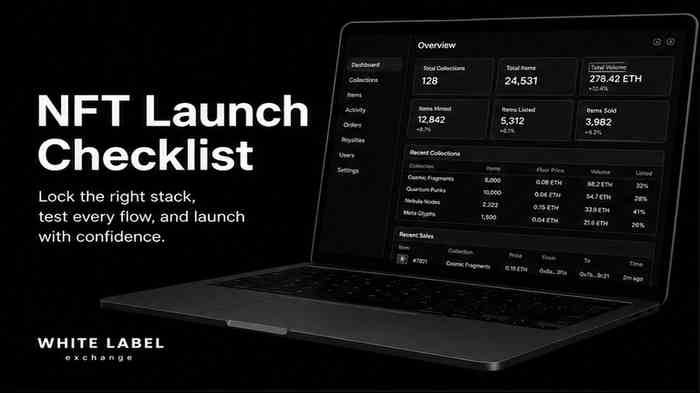
Most NFT marketplace launches stall after branding, not after mint day. A white label NFT marketplace is a pre-built mint-and-trade stack you brand and configure – storefront, contracts, wallets, and admin already exist. Use this operator checklist to pick licensed white-label, SaaS, custom, or clone; lock MVP modules; set chains, royalties, and custody; wire KYC/AML and IP controls; soft-launch with creators; then run the first 30 days with clear metrics.
Summary: Lock delivery model and contract terms (ownership, admin keys, audit match, exit/export) before design. Ship wallets, mint, list/buy, royalty payouts, moderation, and creator payouts for MVP. Publish an ERC-2981 royalty policy you enforce. Soft-launch with about 20–100 creators after full testnet lifecycle, then track daily active wallets, sell-through, and support SLAs in month one.
Vendor pages sell cost bands and “best platforms.” Operators need a go-live sequence. Plain terms: mint creates the NFT on-chain; royalties are creator fees on resales; custody is who holds keys; KYC/AML means identity and anti-money-laundering checks. Bands below are vendor-reported (mid-2026), not WLE pricing. Not legal or investment advice.
Decide model: white-label vs custom build vs clone script
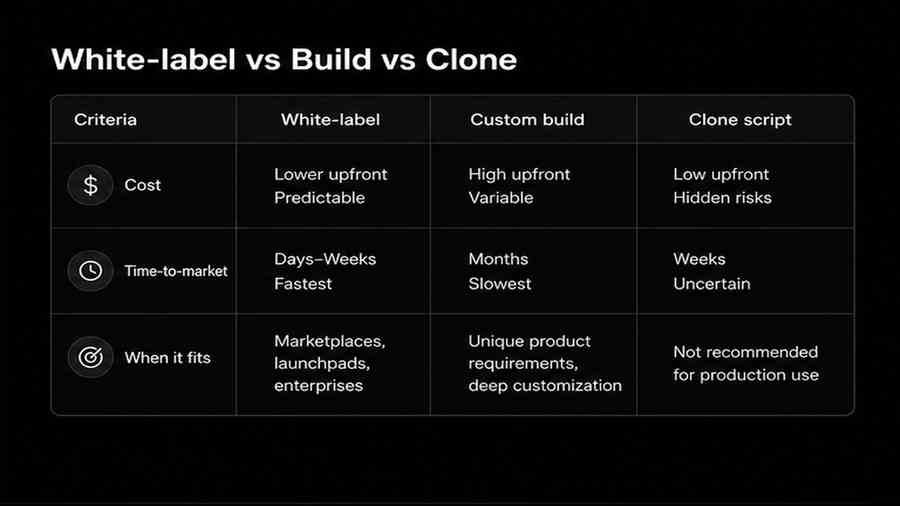
Do not start logo work until you know what you are buying. A white label NFT marketplace (also searched as nft marketplace white label) is licensed or SaaS software you brand. Custom means you design contracts and storefront from scratch. Clone scripts are cheaper UX copies with higher provenance risk. Broader frame: white label vs build a crypto exchange; keep this guide on NFT launch ops.
| Criteria | White-label | Custom build | Clone script |
|---|---|---|---|
| Cost | Lower upfront Predictable |
High upfront Variable |
Low upfront Hidden risks |
| Time-to-market | Days–weeks Fastest |
Months Slowest |
Weeks Uncertain |
| When it fits | Marketplaces, launchpads, enterprises | Unique product needs, deep customization | Not recommended for production |
Vendor-reported detail (mid-2026, not WLE pricing): licensed white-label often ~$10k–$50k one-time or SaaS ~$2k–$10k/month; custom often ~$100k+ over 6–12 months; clone scripts often ~$7k–$20k. White-label typically ships storefront, contracts, wallets, and admin under your brand; custom buys full design ownership; clones trade speed for provenance risk.
Negotiate before branding: IP ownership, admin keys, audit report matching bytecode, data export, and moderation tools. On-chain NFTs travel with users; storefront data often does not. SaaS is usually rental; licensed self-hosting often adds ~$1k–$3k/month hosting (vendor-reported).
Recommendation: Default to white-label when your edge is niche, brand, and creator ops – not a novel token standard. Shortlist vendors as in best white label crypto exchange platforms 2026, then validate royalty and mint paths.
Lock core modules before the first mint or sale
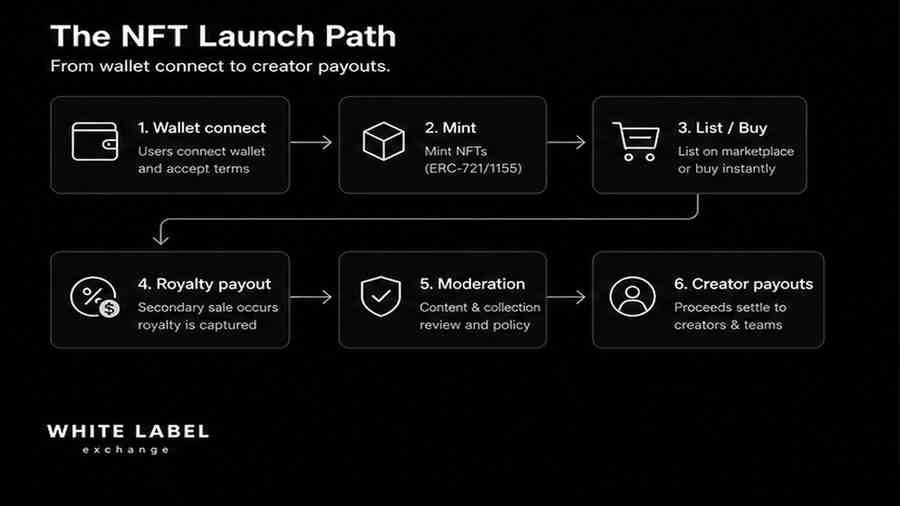
Competing as a generalist OpenSea clone is weak. Pick a vertical (gaming, tickets, creator niche) and ship only modules needed for first mint and first sale:
- Wallet connect for common EOAs (normal user wallets) plus WalletConnect / MetaMask / Coinbase Wallet-style options
- Minting for ERC-721 (unique) and/or ERC-1155 (batchable multi-token) as needed
- Listings: fixed price first; auction only if ops can support bids
- Buy path with clear gas/failure messaging; royalty payout end-to-end
- Admin moderation: hide collection, pause listings, ban abusive wallets
- Creator payouts and fee table (commission, listing, mint fees)
Refuse DeFi lending and multi-chain bridges until first sales clear. Independent audits are often quoted ~$5k–$20k (sometimes ~$30k). For branded infra with NFT Marketplace among Solutions, explore White Label Exchange – still diligence ownership yourself.
Set chains, royalties, and custody that operators underestimate
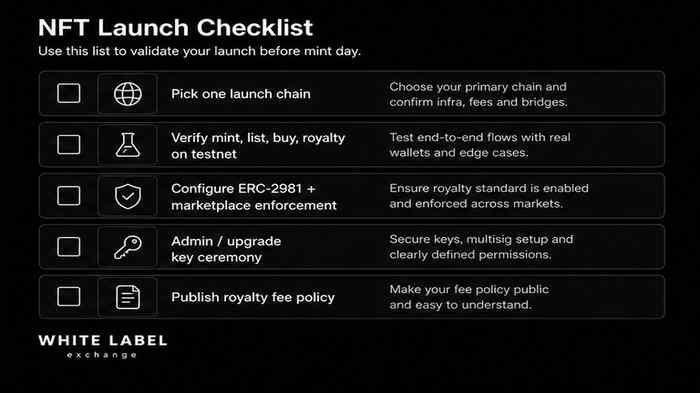
Chain choice is a fee-and-audience call. Operators commonly launch on Ethereum, Polygon, Solana, or BNB Chain. Start with one primary chain; add a second only after mint/list/buy works under load.
Royalties: ERC-2981 lets contracts signal a creator fee via royaltyInfo(tokenId, salePrice) (often basis points / 10,000). Signaling is not payment – your marketplace must enforce it. Publish which sales pay royalties.
Custody: Document admin/upgrade keys, hot-wallet limits, and rotation. If you hold creator or buyer funds, treat that as custody risk and get counsel.
- Pick one launch chain matched to audience and fee tolerance.
- Deploy test contracts; verify mint, list, buy, royalty payout, and refund paths.
- Configure ERC-2981 signaling and marketplace enforcement together.
- Write the admin/upgrade key ceremony; separate hot and cold controls.
- Publish royalty and fee policy before public marketing.
On practice: First mint, then first sale, then first royalty payout – in that order on testnet with real wallets. Skip any one and you will debug it live with angry creators.
Run the compliance, KYC/AML, and IP risk checklist
Legality depends on jurisdiction, fiat on-ramps, custody, IP, and privacy. Software is not a license. Start from crypto exchange compliance checklist for founders, then add NFT IP controls. Deep AML tooling stays on the live AML guides – do not rehash exchange screening here.
- Engage counsel for launch markets before public ads.
- Set KYC/AML if you offer fiat on-ramps or custodial balances (vendor-reported integrations often ~$5k–$15k plus per-check fees; Sumsub/Jumio are examples, not endorsements).
- Publish listing policy and how copy-mints are handled.
- Stand up an IP / takedown workflow with a public contact and SLA.
- Ship ToS, privacy, and creator terms that match product behavior.
- Log moderation actions for disputes and takedowns.
Popular mistake: open mint with no takedown path. Stolen art burns trust faster than a missing theme.
Complete the go-live checklist and first 30 days ops
Soft-launch practice from 2026 operator guides: private beta of about 20–30 creators, or a wider soft launch of about 50–100, after testnet proves the full lifecycle.
Before public launch
- Niche and fee model documented
- Vendor contract: ownership, admin keys, audit matched to bytecode, exit/export, SLA
- Branding, domain, wallets configured
- Testnet mint / list / buy / royalty / refund tested
- Royalty policy published (ERC-2981 + enforcement)
- Admin key ceremony documented; KYC/AML connected if required
- Content policy + IP takedown live; ToS / privacy / creator terms published
- Monitoring for failed txs and stuck payouts; invite soft launch done
First 30 days
- Daily review of failed mints, sales, and royalty payouts
- Track daily active wallets, sell-through, average sale, takedown count
- Creator support SLA (same business day for payout issues)
- Moderation for copy-mints; fee/royalty tuning from real volume
- Incident postmortems within 48 hours of critical failures
Workflow in one line: Lock model, then ship MVP modules, then set chain/royalty/custody, then wire compliance and IP, then soft-launch creators, then open public marketing after month-one metrics look stable.
What to do next
- Write a one-page memo: licensed white-label, SaaS, custom, or clone – plus ownership and exit terms you will not waive.
- Mark MVP modules done / not done; cut anything not needed for first sale.
- Draft royalty enforcement policy and admin-key ceremony with tech and counsel.
- Schedule a closed creator beta (about 20–100) with mint/list/buy/royalty drills.
- Define month-one dashboards: daily active wallets, sell-through, payout failures, takedowns.
Comparing white-label NFT marketplace development vs custom? Explore Solutions on whitelabelexchange.io or more guides on the White Label Exchange blog.
Material reviewed: White Label Exchange Editorial.
Data note: Cost, timeline, and soft-launch patterns attributed to vendor guides and EIP-721 / EIP-1155 / EIP-2981 (OpenZeppelin) in research notes as of 12 August 2026. Ahrefs US: primary “white label nft marketplace” ~200 monthly searches, KD 8. Vendor-reported ranges, not WLE pricing. Not legal or investment advice.
Frequently asked questions
What is a white label NFT marketplace?
A pre-built mint-and-trade platform you brand and configure. Contracts, wallets, storefront, and admin already exist – you set fees, chains, and policies instead of building every module from zero.
How much does a white label NFT marketplace cost?
Vendor-reported licensed bands often ~$10,000–$50,000 one-time; SaaS roughly $2,000–$10,000/month; clone scripts ~$7,000–$20,000. Add audit, KYC, and hosting. Not White Label Exchange list prices.
How long does it take to launch?
SaaS can be days. Licensed white-label is often 2–6 weeks, up to about 8–12 with customization. Custom builds take months. Legal work can exceed engineering.
What is the difference between NFT marketplace software and a custom build?
Software / white-label validates a niche faster. Choose custom for unique on-chain mechanics or ownership a vendor stack cannot meet. Hybrid (white-label core plus custom UX) is common.
Do I own the platform and the code?
Only if the contract says so. SaaS is usually rental. Require written license scope, admin keys, data export, and audit reports matching deployed bytecode before branding.
Are creator royalties guaranteed on-chain?
No. ERC-2981 signals the amount; your marketplace must enforce payment. Publish rules and test royalty payouts on testnet before public launch.
Do NFT marketplaces need KYC and AML?
Depends on jurisdiction, fiat on-ramps, and custody. Crypto-only browse-and-sign still needs IP and ToS. Talk to counsel before public launch – software is not compliance.