Set Up a White-Label OTC Desk: RFQ and Settlement Checklist
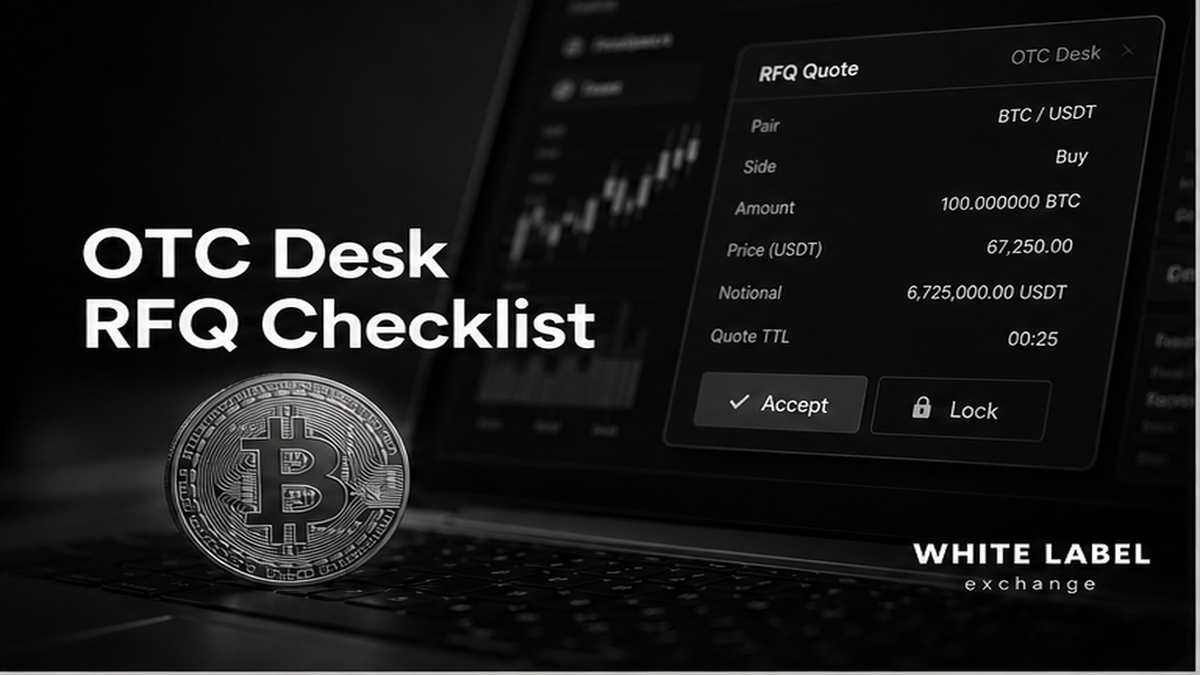
A $5M BTC buy on a thin public book can slip ~1–3% – that is $50k–$150k of avoidable cost, which is why institutions push block flow to OTC. Chat-and-spreadsheet desks break when tickets, hedges, and bank rails pile up. Use this white label otc desk rfq checklist to lock principal vs agency, configure RFQ TTL and price lock, wire liquidity and settlement, then clear KYB/AML before clients trade.
TL;DR / Quick take: Lock principal, agency, or blended first – that sets capital, inventory, and quote firmness. Configure RFQ (request → firm quote with TTL → accept → lock), wire liquidity with markup and hedges, pick settlement (pre-funded → netting → DvP), then clear KYB/AML go-live. Software often ships in 2–10 weeks; fiat rails can take 3–6 months – start banking early.
OTC means bilateral block trading off the public order book. RFQ (request-for-quote): client asks for a price on size and side, desk returns a timed quote, acceptance locks the trade. A white-label stack supplies the RFQ engine, LP routing, custody hooks, and compliance rails under your brand.
1. Choose principal vs agency before you configure RFQ
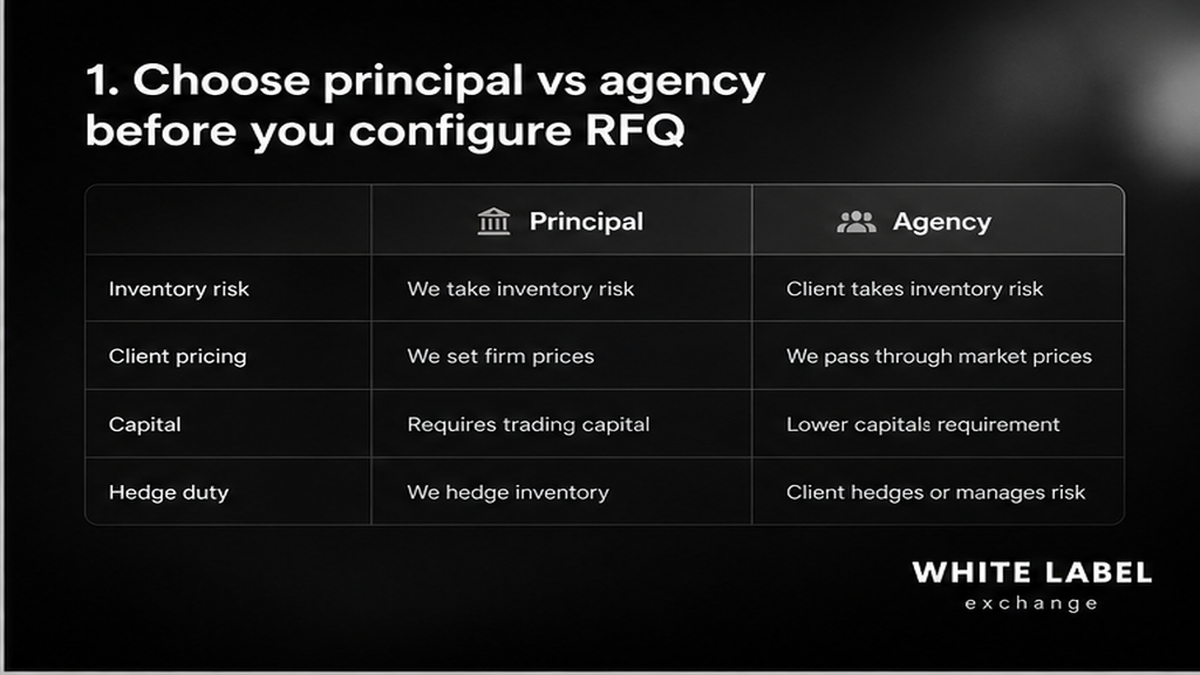
Do not tune TTL or spreads until the model is written down. Principal = you hold inventory and take market risk. Agency = you route to liquidity providers (LPs – firms that quote you) and earn a fee or markup. Blended mixes both by pair or tier.
| Model | Capital / risk | Typical economics (vendor ranges) | Best launch use |
|---|---|---|---|
| Agency | Low inventory; credit and routing risk | ~10–25 bps margin | Day-one desk with limited treasury |
| Principal | Inventory + hedge risk | ~30–75 bps spreads | Pairs where you can fund and hedge |
| RFQ marketplace fee | Platform / matching role | ~5–15 bps fees | Later, if you host multi-dealer flow |
Operator guides often cite a blended book around ~70% agency / ~30% principal by volume, with mid-size principal inventory examples of ~$2–5M across 3–5 assets – vendor planning ranges, not guarantees. Do: start agency on most pairs, document the model per quote, add principal only where inventory and hedges exist. Don’t: promise firm principal prices without inventory limits and a hedge route.
2. Set up the RFQ workflow: request, quote TTL, accept, and lock
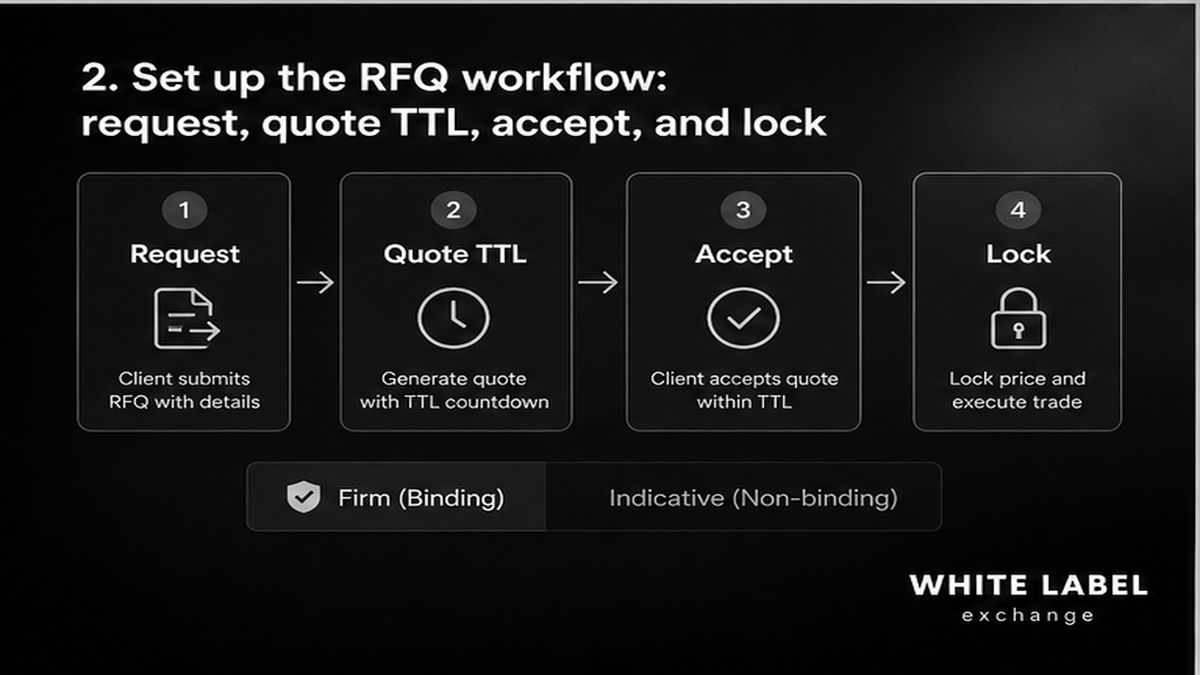
RFQ is the product. Configure these rules before any UI polish.
- Define required request fields: pair, size, side, and settlement preference (crypto, stablecoin, or fiat).
- Choose firm vs indicative: firm can be locked; indicative is guidance only – label both.
- Set quote TTL: how long the quote stays valid. Stablecoin/block windows often sit in 5–30 seconds; some desks use ~10 seconds for firm locks.
- Wire accept / reject / expire: on accept, lock price and size; on reject or expire, release holds and log.
- Emit a trade confirmation on accept (pair, size, price, model, settlement instructions, timestamp).
- Keep an immutable audit log of request, quote, accept, cancel, and dealer identity.
RFQ → settlement workflow:
Client request (pair/size/side) → Desk or LP quote with TTL → Client accepts → Price lock + booking → Confirmation → Settlement rail → Reconciliation → Exception handling
Do: test expire and fail paths in staging. Don’t: run production RFQ on chat without TTL, firmness flags, and archived confirmations.
3. Configure liquidity, pricing spreads, and hedge routing
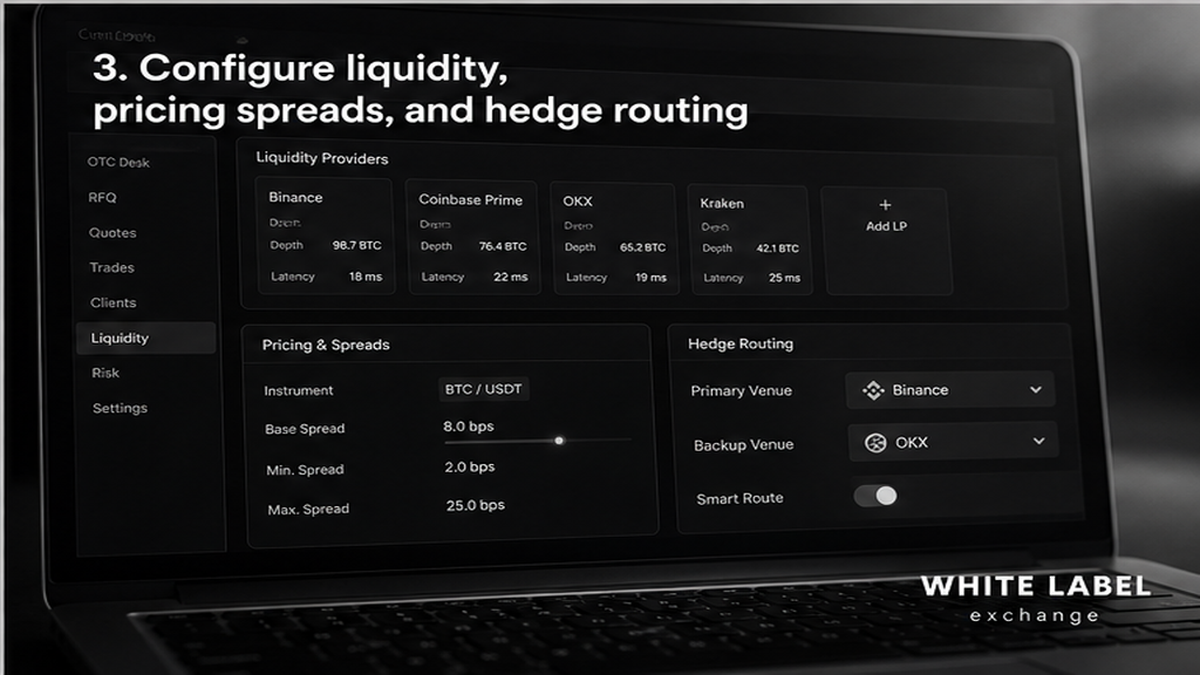
A single LP launches faster but creates pricing and uptime risk. Prefer multi-LP once the first path works. Markup (your spread on top of LP or mid) should vary by tier and ticket size.
- Connect at least one live LP path per launch pair; plan a failover source.
- Set markup / spread tables by tier and model (agency vs principal).
- Define hedge routing: internal book, external venues, or LP fill – plus max quote size by inventory or credit.
- Cap quote size so dealers cannot publish a firm price you cannot settle.
- Monitor reject rates and stale quotes – if TTL expires too often, tighten LP latency or widen carefully.
For spot book-building, reuse how to add liquidity to a new crypto exchange. Finery’s 2026 OTC framing shows institutional OTC stablecoin share rising from 23% (2023) to 78% (2025) – design USDC/USDT rails, not BTC-only. Do: publish max ticket and spread rules before go-live. Don’t: hide markup in one operator’s head.
4. Build settlement and custody rails for fiat and crypto
Settlement is how assets move after the RFQ locks. Pick a day-one model, then upgrade as volume grows.
| Settlement model | How it works (plain English) | When to use |
|---|---|---|
| Pre-funded | Both sides hold balances on your rails before trade | Simplest exchange day-one start |
| Daily netting | Offset many trades; settle the net once | Trusted, high-frequency counterparties |
| DvP via custody | Delivery-versus-payment via custodians (Fireblocks, BitGo, Copper ClearLoop) | Institutional tickets needing controlled rails |
| Atomic / on-chain swap | On-chain exchange of assets in one workflow | Crypto-native pairs when rails support it |
Desks often offer T+0 (same-day) settlement for major tokens; fiat withdrawal can still take 12–24 hours in vendor examples – set expectations in writing. Start wallet policy early (hot/warm/cold or MPC) and address whitelists. Banking often takes 3–6 months – the longest path even when software is ready. See the custody hot/cold/MPC checklist for wallet policy detail.
Do: issue a settlement receipt every time. Don’t: market T+0 crypto while fiat SLAs are undefined.
5. Checklist: KYB, AML monitoring, and go-live controls
KYB is know-your-business: entity identity, ultimate beneficial owners (UBOs), and who may trade. Retail KYC alone is not enough. Large tickets (e.g. $5M) typically trigger enhanced due diligence. Travel Rule framing in operator guides applies to VASP transfers above $1,000 – wire hooks before the first transfer.
Tick every line before public clients:
- Entity KYB + UBO files complete for each counterparty
- Sanctions and AML screening on entities and authorized traders
- Source-of-funds notes for large tickets
- Authorized trader list with dual approval above a size threshold
- Counterparty credit / pre-funding limits in the RFQ engine
- Travel Rule-ready metadata on qualifying transfers
- Monitoring for OTC patterns (unusual size, rapid cancel/requote)
- Information barriers: OTC pending orders separated from proprietary trading / MM / listings
- Templates: trade confirmation + settlement receipt archived
- Immutable RFQ audit log exportable for auditors
- Dealer vs client roles and permissions tested
- Pilot: RFQ → accept → booking → confirmation → settlement → reconciliation → exceptions
- White-label checks: markup, limits, reports, settlement instructions
- Bank / fiat status: live, pending, or out of scope for v1
Institutional onboarding often takes 2–4 weeks (complex cases 6–8). Align with the crypto exchange compliance checklist for founders. Need a packaged RFQ + settlement stack under your brand? Review White Label Exchange solutions after the checklist – not instead of it.
Do: pilot on a closed group until reconciliation works. Don’t: market while banking is “in progress” with no interim settlement story.
What to do next
- Write principal vs agency (or blended) per pair and capital limits.
- Configure RFQ fields, firm/indicative, TTL, accept lock, and audit log in staging.
- Connect LP paths, markup, and hedges; cap max firm quote size.
- Choose day-one settlement (usually pre-funded), set T+0/T+1 and fiat cutoffs, start bank onboarding now.
- Clear KYB/AML go-live, run one RFQ→settlement pilot, then expand distribution.
For more operator playbooks, browse the White Label Exchange blog.
Fact-checked: White Label Exchange Editorial.
Data notes: Steps and ranges from 2026 operator sources in research notes (Finery, Merehead, Codono, Fuze, FinchTrade, Pixelplex) as of July 2026. Wordstat for English OTC phrases was partial; no invented volumes. Operational hygiene only – not legal or investment advice.
Frequently asked questions
What is an RFQ workflow on an OTC desk?
Client submits pair, size, and side. Return a firm or indicative quote with TTL. On accept, lock price, book, confirm, and start settlement. Configure TTL, firmness labels, and immutable logging before go-live.
White-label OTC desk vs spot exchange – what is the difference?
Use spot for continuous public order-book matching. Use OTC RFQ for permissioned bilateral blocks with negotiated size and controlled settlement. For fixed prices on large tickets, ship OTC rails – do not force flow onto a thin book.
How do you settle large OTC crypto trades?
Start pre-funded on your rails. Scale to daily netting for trusted flow, then DvP via custody networks (Fireblocks, Copper ClearLoop, BitGo) for larger counterparties. Issue confirmation and settlement receipt every time.
Should we launch as principal or agency?
Most new desks start agency (lower capital and market risk), then add principal where inventory and hedges exist. Document the model per quote so dealers and compliance share one rule set.
How long does a white-label OTC launch take?
Treat software as roughly 2–10 weeks depending on vendor. Banking usually dominates. Start fiat rails 3–6 months ahead of public marketing.
What compliance is required before the first trade?
Complete entity KYB, sanctions/AML screening, authorized traders, Travel Rule-ready transfers, OTC surveillance, and archived quote/trade logs. Do not treat retail KYC alone as desk readiness.