How to Set Up Perpetual Futures on a White-Label Crypto Exchange: Operator Checklist
Turning on perpetual futures with spot-era risk controls is how venues get liquidation cascades and socialized losses on day one. This operator checklist covers how to set up perpetual futures on a white-label crypto exchange: lock USDT-M vs coin-M scope, wire mark/index oracles plus margin and liquidation, set funding and maker-taker fees with MM APIs, stress-test under load, then run go-live and first-30-days ops. You leave with a written go/no-go before public BTC-PERP.
TL;DR / Quick take: Treat perps as a derivatives product, not a UI toggle. Scope 3-5 pairs (usually BTC/ETH/SOL-PERP), liquidate on mark from a multi-venue index (never last trade), fund insurance with ADL as last resort, start funding near industry 8h UTC stamps, seed MM depth, then pass coordinated stress before listing. Fail any gate = delay go-live.
White-label means a ready CEX stack you brand and operate instead of building from scratch. Perps are leveraged contracts with no expiry; funding keeps them near spot. Assume the stack is chosen – you configure risk, funding, liquidity, and ops. Not legal or investment advice; confirm markets with counsel. See MiCA vs VARA jurisdiction comparison.
1. Confirm product scope: USDT-M vs coin-M, leverage, and pair shortlist
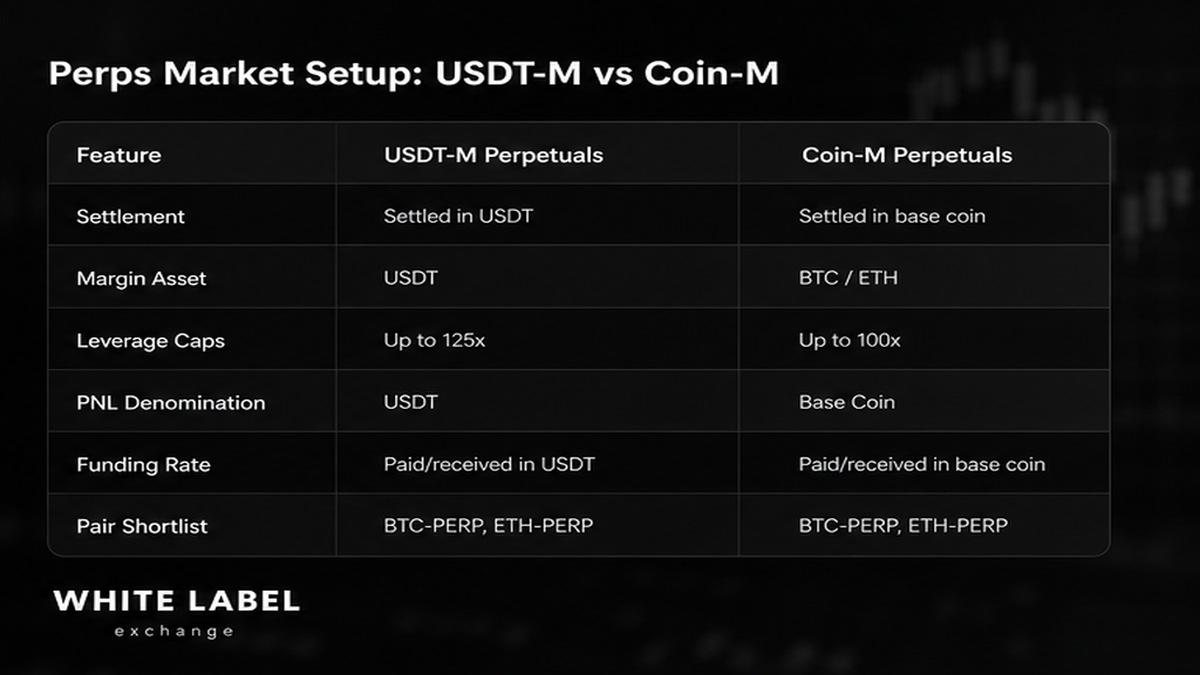
USDT-M (USD-M) uses stablecoin collateral – simpler for retail. Coin-M (inverse) uses the underlying coin as margin – better later for coin-heavy desks. Max leverage multiplies notional size; isolated locks risk to one position, cross shares collateral. Pros usually expect both modes.
| Choice | USDT-M | Coin-M |
|---|---|---|
| Collateral | Stablecoin; easier retail UX | Native coin; more accounting edge cases |
| Who first | Retail-first venues | Hedge desks / coin treasuries |
| Day-1 call | Start here on 3-5 pairs | Add after separate accounting tests |
| Do not | List every altcoin PERP on day 1 | Enable both without dual bookkeeping drills |
- Pick margin model – default USDT-M; document coin-M as phase two.
- Shortlist 3-5 pairs – typically BTC-PERP, ETH-PERP, SOL-PERP.
- Cap max leverage per tier and write isolated vs cross policy before marketing.
- List allowed collateral and a written listing policy for new PERPs.
- Get counsel sign-off for target markets – perps are heavier than spot.
Do this: freeze scope in a one-page brief before risk configs. Do not treat “derivatives module on” as readiness.
2. Wire risk engines: mark/index oracles, margin, liquidation, insurance
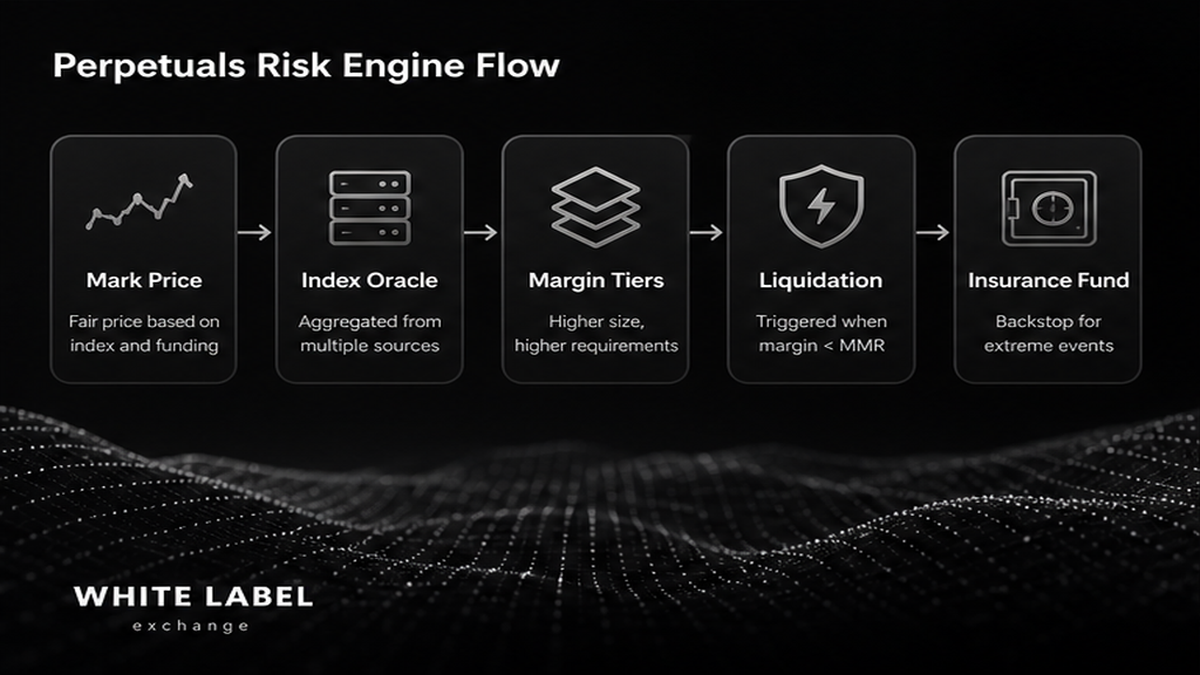
Index price is a blended spot reading from several exchanges; mark price is the fair value for unrealized PnL and liquidations. Binance Futures documents mark (not last trade) for liquidations, built from a multi-venue index plus basis smoothing. Last-price liquidation invites spoofing and cascades. Maintenance margin is the floor to keep a position; initial margin opens it. Below maintenance, liquidation closes risk – preferably partial, then full. An insurance fund absorbs leftover losses; ADL (auto-deleveraging) ranks opposing profitable traders when the fund is thin. Kill switches pause trading when something breaks.
- Wire multi-source index → mark with composition versioned in config.
- Define stale/thin-feed fallbacks (drop a venue, widen bands, or halt).
- Configure margin tiers, max position, and order size per pair.
- Enable partial-then-full liquidation; never liquidate solely on last price.
- Capitalize the insurance fund; set ADL as last resort.
- Name kill-switch owners and rehearse who can halt matching or listings.
Common 2026 failure modes: thin single-source index, liquidations tested without matching load, and a thin insurance fund that forces surprise ADL. Do this: treat mark, margin, liquidation, insurance, and ADL as one system. Do not ship BTC-PERP until mark/index redundancy passes a thin-pair drill.
3. Configure funding-rate schedule, maker-taker fees, and MM API access
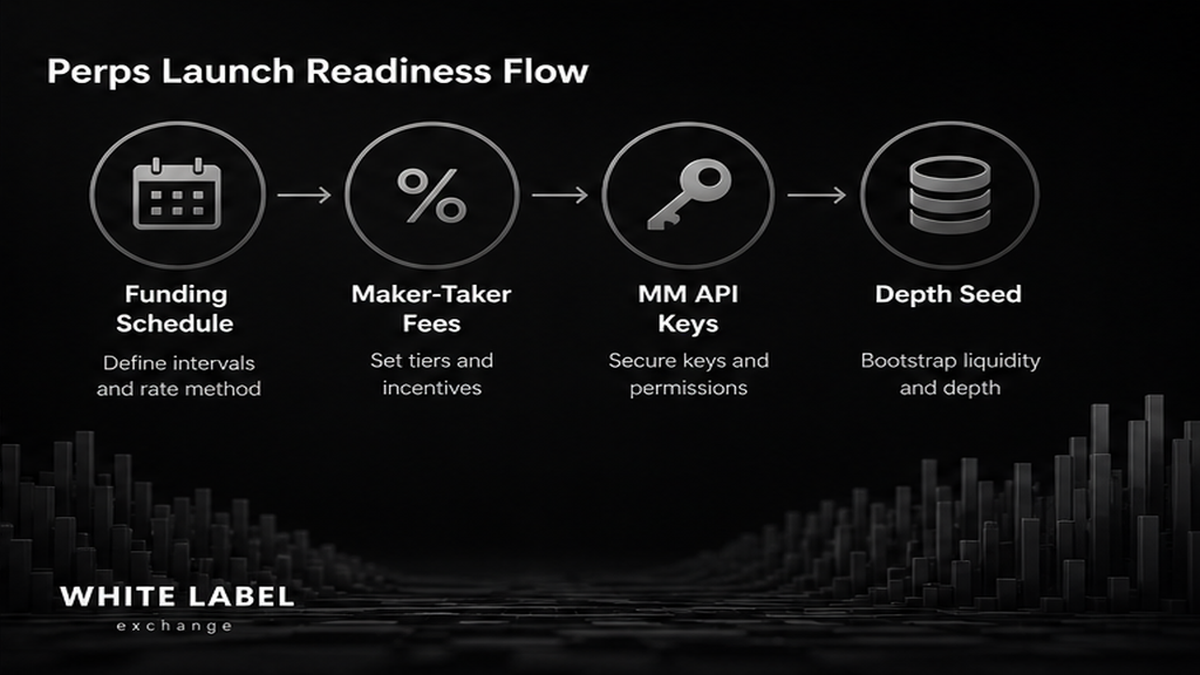
Funding is a periodic payment between longs and shorts so the perp stays near spot. Binance Futures typically settles every 8h at 00:00 / 08:00 / 16:00 UTC (some pairs every 4h), only if a position is open at settlement. Bybit uses the same stamps and can auto-switch to faster settlement (including 1h) when rates hit caps (restore rules updated in 2026). Maker-taker fees price resting liquidity (makers) differently from orders that take it (takers).
- Start funding at 8h UTC stamps unless a pair needs 4h; show predicted funding.
- Set rate caps to your open interest and depth – do not paste a mega-venue formula.
- Decide if liquidation fees feed insurance (some venues charge an insurance clearance fee).
- Publish maker-taker with MM rebates tied to depth/spread SLAs – see fee structure design.
- Provision MM accounts with REST/FIX access, rate limits, and depth targets.
Workflow:
Scope (USDT-M / pairs / leverage) → Oracles + risk engines → Funding + fees + MM APIs → Liquidity seed → Stress drills → Public listing → 30-day ops
Validate configs on a stack that already ships derivatives modules. Soft-check White Label Exchange when you need matching, liquidation, and funding without a greenfield build – still run your stress gates. Do this: publish predicted funding before listing. Do not copy funding params from a much larger venue.
4. Seed liquidity and stress-test liquidations before public listing
Liquidity means traders can enter and exit near fair price without moving the book. Empty books kill launches; see how to add liquidity. Write-ups often suggest 3-5 core pairs and a separate early MM reserve (mid-six-figure planning band – input, not a rule).
| Stress gate | Pass | Fail (delay) |
|---|---|---|
| Gap + OI surge | Liquidations within latency under load | Queue stalls or mark lags index |
| Insurance | Fund covers scripted shortfalls | Immediate ADL on mild scenarios |
| Funding settlement | Correct PnL; predicted funding matches | Wrong balances or interval |
| MM depth/spread | Targets held on launch pairs | Book evaporates under synthetic flow |
- Seed books offline until depth/spread SLAs hold on launch pairs.
- Replay gap moves and coordinated OI spikes under matching load.
- Verify liquidation latency, insurance draws, funding settlement, and ADL order.
- Fail = delay – UI polish does not override a failed stress gate.
Do this: run funding + liquidation + insurance as one drill. Do not test liquidations alone on an empty matching engine. Still choosing build vs buy? See white-label vs build.
5. Go-live checklist: monitoring, kill switches, and first-30-days ops
Go-live is an ops event. Dashboards, on-call, and an incident runbook must exist before marketing.
- Mark vs index lag alert with named owner
- Open interest and liquidation-cluster monitor
- Insurance fund balance and draw alerts
- Funding outlier and settlement-failure alerts
- Matching-engine latency and error budget
- Kill switch rehearsal logged (who, when, result)
- On-call rotation for first 14 nights
- Daily liquidity review for 14 days
- Weekly risk-parameter review for 30 days
- Trade surveillance for wash, spoof, abnormal liquidations
- Public status path for halt/resume notices
- Post-mortem template ready before first incident
- Flip pairs only after stress pass and insurance policy sign-off.
- Keep kill switches rehearsed – pause listing or matching without committee delay.
- Run 14-day daily liquidity reviews, then weekly risk reviews through day 30.
- Escalate market changes through counsel before widening pairs.
Do this: treat the first 30 days as a controlled rollout with written gates. Do not expand to thin alt PERPs until BTC/ETH/SOL ops are stable.
What to do next
Lock scope, finish oracle/risk configs, publish funding and fees, seed MM depth, pass stress, then list with kill switches rehearsed. More guides: White Label Exchange blog. When the checklist is green and you need derivatives risk modules, talk via White Label Exchange.
Reviewed by: White Label Exchange Editorial (white-label exchanges, exchangers, P2P, derivatives-ready stacks).
Data integrity: Funding and mark cite Binance Futures FAQs (January 2026) and Bybit funding/mark docs plus the February 2026 dynamic funding-interval update. Failure modes: Brokeret (2026-07-23), Merehead (May 2026), Troniex perpetual launch checklist (July 2026). Vendor timelines are planning ranges only. No English Wordstat volumes invented.
Frequently asked questions
What modules do you need before listing BTC-PERP?
Matching, risk engine, multi-source index → mark, margin tiers, partial-then-full liquidation, insurance with ADL, funding with predicted-funding UI, MM APIs, monitoring, and kill switches. Missing a piece? Keep the pair in private drill mode.
How do you set funding-rate intervals on a white-label CEX?
Start with 8 hours at 00:00 / 08:00 / 16:00 UTC unless the pair needs 4 hours. Add rate caps and optional faster settlement under stress, show predicted funding, and calibrate clamps to your OI and depth – do not paste a mega-venue formula.
When is a new exchange ready for perpetual futures?
When stress tests pass under matching load, insurance meets policy, mark/index redundancy works on thin pairs, MM depth hits launch SLAs, and on-call plus kill switches are rehearsed. UI alone is not readiness.
Should you launch USDT-M or coin-M perpetuals first?
Start USDT-M for simpler collateral UX; add coin-M when coin-heavy desks need native hedges. Do not enable both without separate accounting and settlement tests.
Mark price or last price for liquidations?
Always use mark price anchored to a multi-venue index. Last-price liquidation raises manipulation and cascade risk. Document index composition, fallbacks, and who can halt a pair.