
Choosing white label vs building a crypto exchange from scratch is a capital and calendar call, not a logo debate. White-label means a pre-built, brandable trading stack – matching engine, wallets, admin, compliance hooks – under your brand. Custom means you design and own those systems. Score budget, timeline, team, and edge; fill a cost-team-compliance table; list hidden post-launch work; leave with custom, white-label, or hybrid.
TL;DR / Quick insight: Default to white-label or hybrid unless you need proprietary matching, custody, or architecture – plus ~$300K–$1M+ tech budget and an 8–18 month runway. White-label often ships in weeks to a few months; full custom CEX is usually high six to seven figures over many months. Licensing, liquidity, support, and audits stay on you either way.
Most SERP pages sell “buy our white-label.” You need a decision sequence. Plain terms: a matching engine pairs buy and sell orders; custody is how user crypto is held; KYC/AML means identity and anti-money-laundering checks; TCO is total cost after launch. Not legal or investment advice. Bands below are vendor-reported (mid-2026), not WLE prices.
1. Decide when a custom build is justified
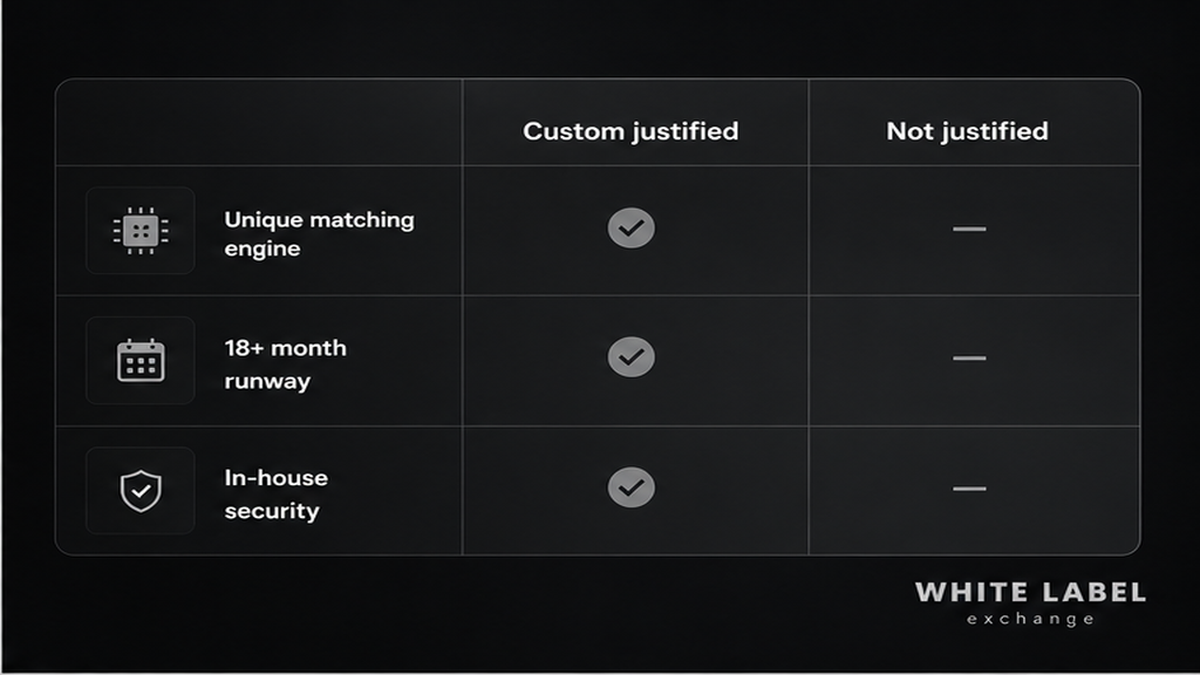
Custom pays when the product is the engine – unique order types, proprietary custody, institutional latency, or architecture you cannot license. Codono and Errna (2026) frame custom for deep pockets, unique tech needs, and a team that can own matching, wallets, and security for years. Full custom CEX: about $300K–$1.5M+ over ~8–12 months (Pharos); institutional often $650K–$1.3M+ over 12–18 months (Antier). MVP also framed ~$250K–$1.2M over ~6–9 months (Palmidos). Sub-$50K or sub-90-day “full CEX” quotes often mean UI on someone else’s stack.
- Write whether your edge is brand/GTM or proprietary trading tech.
- Confirm tech budget can absorb ~$300K+ before marketing and licenses.
- Confirm you can wait ~8–18 months before public launch.
- Name who owns matching, custody, security, and DevOps after go-live.
- Accept full TCO: audits, compliance updates, and infra.
Do choose custom when most checks are true. Don’t greenfield because “we can code it cheaper.”
Recommendation: If your edge is market, liquidity partnerships, or brand – not engine IP – skip custom for day one. Revisit after product proof and a team that can own core systems.
2. Choose white-label when time-to-market wins
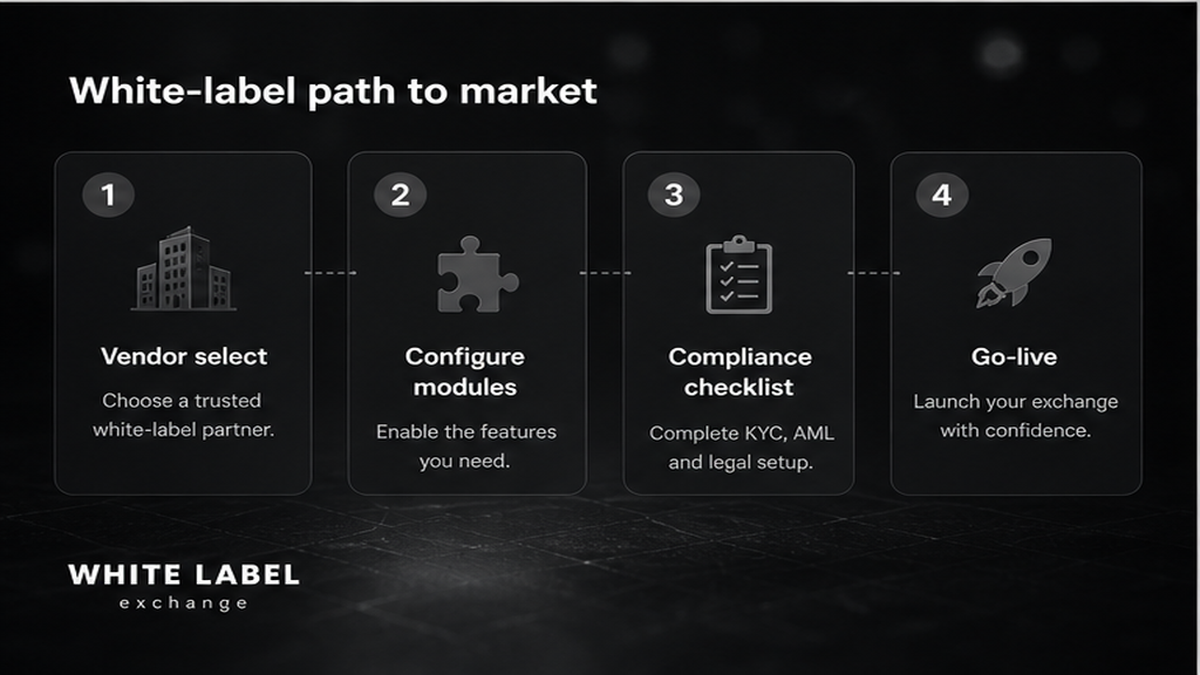
White-label wins when you need a production stack in weeks to a few months, your edge is brand, geography, or GTM, and you lack a full exchange-specialist eng team. Vendors often claim white-label is ~60–80% cheaper than custom (Merehead, May 2026). Deployment is commonly 4–12 weeks depending on customization, compliance, and fiat rails; others cite 4–8 weeks. Optimistic “2–4 weeks” ignores legal work.
Separate forks before vendor calls: SaaS white-label (vendor hosts; monthly fees often ~$2,000–$15,000+/month) versus source-code transfer (you host and audit). Also separate a cheap script (more DIY) from a fuller white-label stack – see script vs white-label. Pros: speed, lower upfront, vendor maintenance. Cons: limited core control, shared roadmap, recurring fees, possible revenue share. Ask exit before SaaS. Spot-first is the sane default. Do shortlist vendors with audit rights, liquidity models, SLAs, and an exit path. Don’t pick the cheapest license without load and compliance diligence.
Verdict: For most first launches, white-label or hybrid (WL core plus custom UI/rails/risk in ~2–4 months; Pharos ~$80K–$300K) beats from-scratch. Soft-check a ready stack at White Label Exchange when calendar pressure dominates – still diligence SaaS vs source code.
3. Fill the cost, team, and compliance comparison table
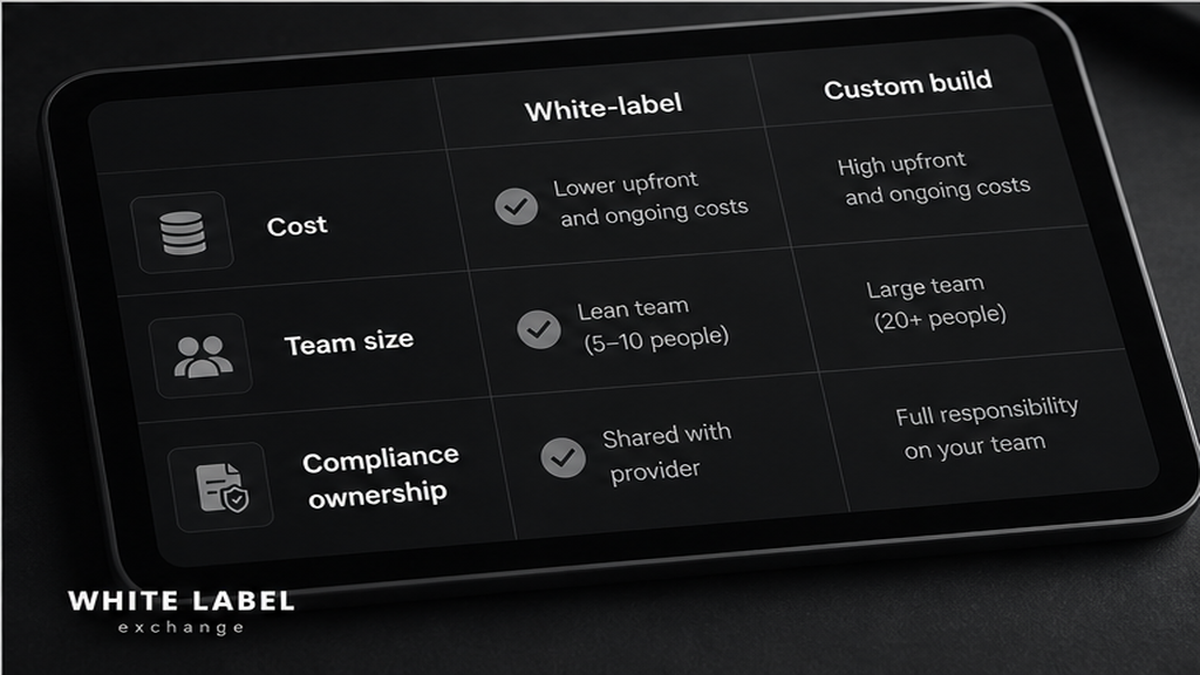
Build one board table with attributed ranges. 2026 white-label software quotes cluster roughly $8K–$150K (Suffescom/Hashcodex), $30K–$100K (Pharos), or $45K–$120K with security uplift (Antier). Merehead also breaks spot ~$20K–$30K, margin ~$30K–$50K, futures ~$60K–$150K – see white-label exchange cost 2026.
| Criterion | White-label | Custom from scratch | Hybrid |
|---|---|---|---|
| Software cost (vendor-reported) | ~$8K–$150K+ by module depth | ~$300K–$1.5M+ full CEX | ~$80K–$300K (core + custom layer) |
| Time-to-market | ~4–12 weeks (legal may exceed) | ~8–18 months | ~2–4 months WL core + modules |
| Team needed | Small ops + product | Full eng + security + DevOps | Product + selective custom eng |
| Customization | Brand/modules in vendor roadmap | Full architecture control | Custom UX/rails on shared core |
| Compliance | Still yours (VASP/MiCA/VARA) | Still yours | Still yours |
| Maintenance | Vendor updates + your ops; SaaS fees | Your eng forever (~$15K–$30K/mo) | Vendor core + your module owners |
Licensing is often the largest line: crypto-friendly jurisdictions sometimes ~$30K–$100K; multi-state US MTL coverage can reach ~$500K–$2M (Pharos). EU VASP/MiCA paths often ~3–6 months; UAE VARA ~4–6 months (Merehead FAQ) – consult counsel. Software never equals a license. Do start counsel in parallel with software. Don’t ignore audits (~$30K–$80K), LP integration (~$30K–$50K), or infra (~$5K–$15K/mo).
Workflow: Constraints → Fork (script / WL SaaS / WL source / custom / hybrid) → Table → Hidden-work budget → Path pick → Vendor diligence
4. Price the hidden work after launch
Any path still needs five systems: order book/matching, wallet/custody, liquidity, KYC/AML, and trading UI plus settlement. Rough framing: ~40% code and ~60% ops resilience (Pharos). An empty order book kills launches; plan MM or LP APIs (or inventory) from day one. Modules explained: core modules of a crypto exchange.
- Licensing counsel for target markets
- KYC/AML vendor contracts and policy pages
- Security audit / pen-test before public funds
- Liquidity / MM plan before marketing launch
- 24/7 support and incident runbooks
- Infra, monitoring, and key management
Do assign an owner and budget line before go-live. Don’t treat “software deployed” as launch.
5. Apply the recommendation framework by budget and timeline
Run this in a founder/CTO session.
- Score constraints: budget, must-launch date, eng headcount, differentiator.
- Separate forks: script vs white-label vs custom vs hybrid; SaaS vs source-code.
- Apply “custom only if”: unique architecture, $300K+ tech budget, 8–18+ month runway, ownership team.
- Fill the comparison table with attributed shortlist quotes.
- Price hidden work on both paths: licenses, KYC, audit, liquidity, support, infra.
- Pick by budget + timeline: under ~3 months / under ~$100–150K software → white-label; custom UX fast → hybrid; proprietary engine → custom.
- Vendor diligence: source-code vs SaaS, audit rights, liquidity, SLAs, exit plan, roadmap control.
Decision snapshot: Custom – proprietary engine + capital + long runway + ownership team. White-label – speed, brand/GTM edge, small eng team. Hybrid – WL core now, custom modules in 2–4 months without rewriting matching day one.
Do write the chosen path and rejection reasons on one page. Don’t ignore TCO or revenue-share on a “cheap” license.
What to do next
- Fill the constraint scorecard (budget, date, team, differentiator).
- Build the three-column comparison table with real shortlist quotes.
- Attach the hidden-work checklist with owners and dates.
- Lock custom / white-label / hybrid with a go/no-go date.
- Start licensing counsel in parallel with product.
If white-label or hybrid fits, explore ready solutions at whitelabelexchange.io or browse the White Label Exchange blog.
Material reviewed: White Label Exchange Editorial.
Data note: Cost and timeline bands from 2026 vendor sources in research notes (Merehead, Pharos, Antier, Codono, Palmidos, Errna, and others) as of 16 July 2026. Wordstat unavailable; no fabricated demand. Vendor-reported figures, not WLE pricing. Not legal or investment advice.
Frequently asked questions
Is a white-label crypto exchange safe?
Safety depends on custody design, audits, ops controls, and vendor diligence (SaaS vs source code, SLA, exit plan). White-label is not a substitute for your own compliance and security ownership.
How long does it take to build an exchange from scratch?
Vendor guides typically cite about 8–18 months for a serious custom CEX, longer with derivatives or multi-jurisdiction licensing. Legal can exceed software. Treat sub-90-day “full CEX” quotes with skepticism unless scope is a thin UI on existing infra.
White label vs script – what is the difference?
Scripts are often cheaper codebases with more DIY assembly. White-label usually means a fuller deployable stack with branding, modules, and vendor support – see script vs white-label.
What does custom crypto exchange development cost in 2026?
Widely cited bands sit around $300K–$1.5M+ for a full custom CEX; MVP quotes vary. Always add licensing, liquidity, audits, support, and infra. Treat numbers as vendor-reported until you have a scoped SOW.
When is hybrid better?
When you need white-label speed but require custom UX, rails, or risk modules within a few months – without owning the matching engine on day one.
Does buying white-label remove licensing work?
No. You still need the right entity and authorization for your markets. Software choice does not equal a VASP, MiCA, VARA, or equivalent approval. Start counsel in parallel with vendor selection.
What kills launches after the software is ready?
Empty books (no liquidity), weak support, unfinished compliance, and underestimating TCO or revenue-share. Fix liquidity, runbooks, and licenses first.