
Your matching engine is live, KYC works, and the order book is still empty. That cold-start trap kills launches: traders skip thin markets, and depth never appears without them. This playbook shows how to add liquidity to a crypto exchange – choose a model, connect providers, set maker fees, and prove the books are healthy with hard numbers before go-live.
TL;DR / Quick take: Start with external aggregation (mirror Tier-1 books through a liquidity bridge) for a fast, low-capital launch, then add internal market making on your top three to five pairs as volume grows. Hybrid is the 2026 standard. Judge success by spread, 2% depth, and slippage – not by 24-hour volume alone.
Liquidity means how easily someone buys or sells at a fair price without moving the market. A new venue must import it. For depth basics, see what crypto liquidity is. The steps below are for CEX operators; a short DEX-pool note for retail users sits near the end.
1. Why empty order books kill launches
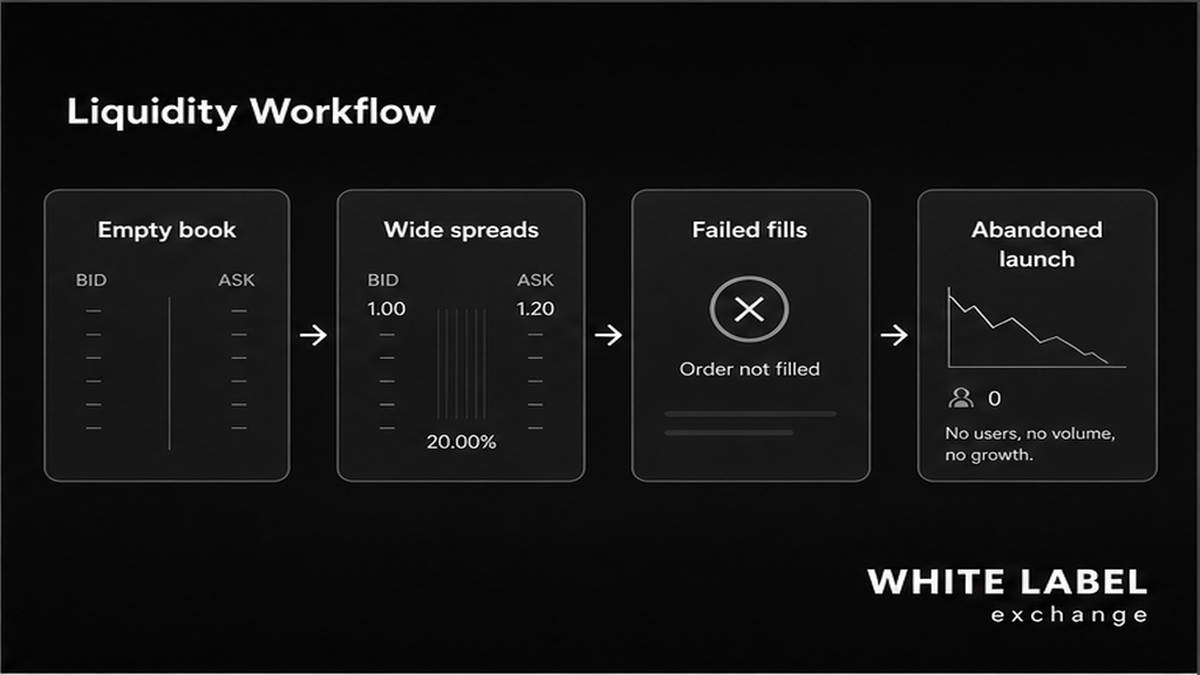
An empty book is a product failure. Wide spreads and thin depth create slippage (price moves against the trader as the order fills), failed fills, and churn after one bad trade. Before any vendor call, set day-one targets: which pairs you open, max bid-ask spread, and min depth within 2% of mid. Keep it narrow – BTC, ETH, and a few stablecoin pairs.
Do this: write numeric targets per pair before integration. Do not launch a pair you cannot keep liquid. Still choosing the build path? Read how to start a crypto exchange, then return here.
2. Options: market makers, LP APIs, internal inventory, aggregators
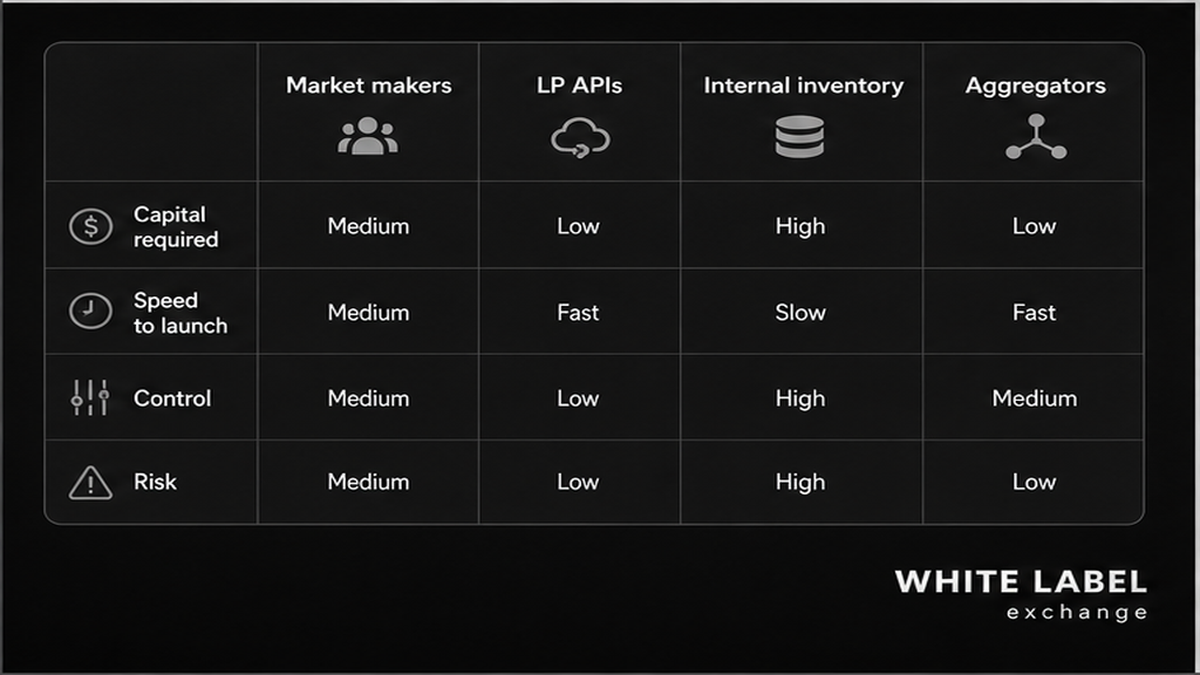
Four practical ways to fill a book – pick by stage and capital, not by pitch decks.
- External aggregation: a liquidity bridge (software that pipes prices and orders from bigger venues) mirrors Binance, Kraken, or Coinbase books onto yours. Fast and capital-light.
- Market-making firms: an external desk posts continuous quotes under depth, spread, and uptime SLAs.
- Internal inventory: you hold the coins and run your own bots. Full control, but inventory capital is real money at risk.
- LP / provider APIs: connect via FIX (a fast trading messaging standard) or REST/WebSocket APIs so external liquidity shows as your own book.
| Criterion | Aggregation | External MM | Internal inventory | Hybrid |
|---|---|---|---|---|
| Upfront capital | Low | Medium (monthly) | High | Medium |
| Time to live | Fastest | Moderate | Slowest | Moderate |
| Spread control | Low | Contractual | Full | High on core pairs |
| Best stage | Pre-launch | Early volume | Established book | Scaling |
Verdict: Launch on aggregation, then add internal or contracted market making on your top three to five pairs once daily volume clears roughly $1M. Hybrid is the 2026 default. Pure aggregation is riskier unless the provider can certify its order-flow source.
3. Connect aggregators and vet market makers
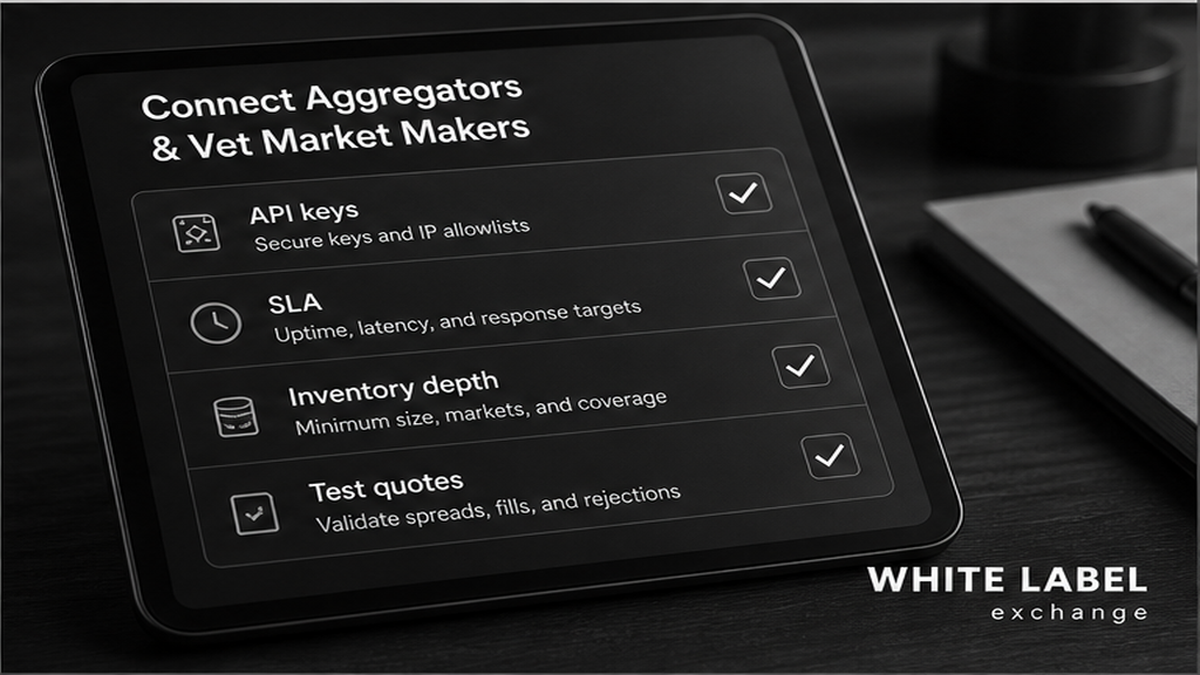
- Shortlist providers that already support your target pairs and matching engine.
- Confirm the connection: FIX, REST, or WebSocket – and whether your engine already speaks it.
- Wire at least two sources so one outage does not empty the book.
- Test failover and latency in staging before real users touch it.
- Budget four to eight weeks for integration. Founders routinely underestimate this by months.
Integration flow:
Pick provider(s) → connect via FIX or REST/WebSocket → add failover → stage test → go live on core pairs.
When you interview a market maker, ask about latency, orders per second, and API protocols. Require compliant order flow and, increasingly in 2026, Proof of Reserves (evidence they hold the assets they quote). Put min depth, max spread, and uptime in writing. Cost ranges are often single-sourced: internal inventory can reportedly run from about $50,000 to millions; outsourced MM commonly costs $5,000-$30,000 per month. Do not sign without measurable targets.
4. Pair selection and maker-incentive fee schedule
Fees are your cheapest liquidity magnet. Makers (traders who add resting orders) deserve the discount; takers (traders who hit those orders) can pay more.
| Exchange (early 2026 base spot) | Maker | Taker |
|---|---|---|
| Binance | 0.10% | 0.10% |
| Kraken | 0.16% | 0.26% |
| Coinbase Advanced | 0.60% | 1.20% |
- Set base fees 20-30% below your main competitor.
- Run a zero-maker promo for three to six months to seed early depth.
- Offer negative maker rebates (roughly -0.01% to -0.03%) on core pairs only.
- Use a clear maker-taker gap; a common structure is 0.10% maker / 0.20% taker. A basis point is one hundredth of a percent.
- Confirm per-account fee tiers in the engine before you advertise rebates.
For new token listings, require an LP commitment – for example around $100,000 depth for a fixed period. Do this: publish fees and quoting obligations before soft launch. Do not open long-tail alts until BTC/ETH books look tight.
5. Monitoring: depth, slippage, and failed fills
Volume is a vanity metric. Track these signals from day one:
- Bid-ask spread in bps: ((best ask – best bid) / mid) x 10,000. Tighter is healthier.
- 2% market depth: dollar value of orders within 2% of mid (CoinGecko/Kaiko-style). Tier-1 BTC/USDT sits in the tens of millions; a thin altcoin shows tens of thousands.
- Slippage curve: simulate $10k, $100k, and $500k market orders and record how far price moves.
- Failed fills / rejects: if aggregation fails under load, users see “order rejected” even when the UI looks liquid.
Review weekly. Past roughly $1M daily volume on a pair, move internal or contracted market making onto it and keep aggregation for the long tail. A white-label stack with built-in aggregation and smart order routing (sends each order to the best available price) shortens this loop – see White Label Exchange. For P2P launch ops that also need seeded depth, use the P2P crypto exchange launch checklist.
6. 14-day liquidity launch workflow
- Days 1-2: lock pairs, day-one spread and 2% depth targets, and the fee schedule.
- Days 3-5: sign the primary aggregator, start FIX/API wiring, shortlist a backup source.
- Days 6-8: negotiate MM/LP quoting obligations and listing depth commitments.
- Days 9-11: staging – failover, latency, dry-run slippage at $10k / $100k / $500k.
- Days 12-13: soft-open to internal and partner accounts; watch failed fills and spread breaches live.
- Day 14: go/no-go. If core pairs miss targets, delay public launch. Do not “fix it in production.”
Workflow:
Targets → aggregator + failover → MM/LP contracts → staging metrics → soft open → go/no-go.
7. Adding liquidity to a DEX pool (retail meaning)
If you searched this as a retail user, you likely mean depositing into a Uniswap-style pool: supply a token pair and earn a cut of trading fees. On Uniswap V4: connect wallet → Pool → select pair → choose fee tier (0.01% / 0.05% / 0.30% / 1%) → set price range (concentrated liquidity) → approve via Permit2 and confirm. You receive an NFT for the position. If price leaves your range, the position goes one-sided and stops earning fees. Impermanent loss (the paper gap between holding versus pooling) hits only if you withdraw while prices have diverged. See the official Uniswap docs. CEX operators: treat this as intent coverage – your job remains sourcing providers and measuring the book.
What to do next
Lock pairs and depth targets, wire aggregation with failover, publish a maker-friendly fee schedule, and stand up depth/slippage dashboards before public trading. Run the 14-day workflow as a hard gate. More: White Label Exchange blog.
Reviewed by: White Label Exchange Editorial (practitioners in white-label exchanges, exchangers, P2P, and liquidity).
Data integrity: fee benchmarks, timelines, and the 2% depth method are cited from public 2026 sources (Spark, Kalena, Dappfort, Errna, Codono, Uniswap Labs). MM costs are ranges (single-source, provider-dependent). Wordstat volumes were unavailable in this research pass and are not asserted here.
Frequently asked questions
How much liquidity does a new exchange need?
Enough that day-one spreads and 2% depth hit the targets you set – typically BTC, ETH, and a few stable pairs. Internal inventory can reportedly run from about $50,000 to millions; outsourced MM commonly costs $5,000-$30,000 per month. Start with aggregation to keep capital low.
What is market making in crypto?
Continuously posting buy and sell quotes so traders always have a counterparty. The maker earns the spread; the exchange gets a tighter book. Run it in-house or hire a firm under written depth, spread, and uptime obligations.
Liquidity vs volume – what is the difference?
Volume is how much traded in a period. Liquidity is how much you can trade now without moving the price. Measure spread, 2% depth, and slippage – do not trust 24-hour volume alone.
Aggregation or market making – which comes first?
Aggregation first for a fast, low-capital launch. Add internal or contracted market making on your top three to five pairs as volume grows. Hybrid is the 2026 standard.
What fees attract market makers to a new exchange?
Base fees 20-30% below the market leader, a zero-maker promo for three to six months, and small negative maker rebates (around -0.01% to -0.03%) on core pairs. Confirm per-account fee tiers first.
How long does it take to connect a liquidity provider?
Typically four to eight weeks, depending on pairs and compliance. Plan for longer rather than shorter, and always wire a second source for failover.
Is adding liquidity to a Uniswap pool the same thing?
No. On a CEX you source liquidity through providers and market makers. On a DEX you deposit a token pair into a pool, pick a fee tier and price range, and take on impermanent-loss risk.