How to Launch a P2P Crypto Exchange: Operator Checklist
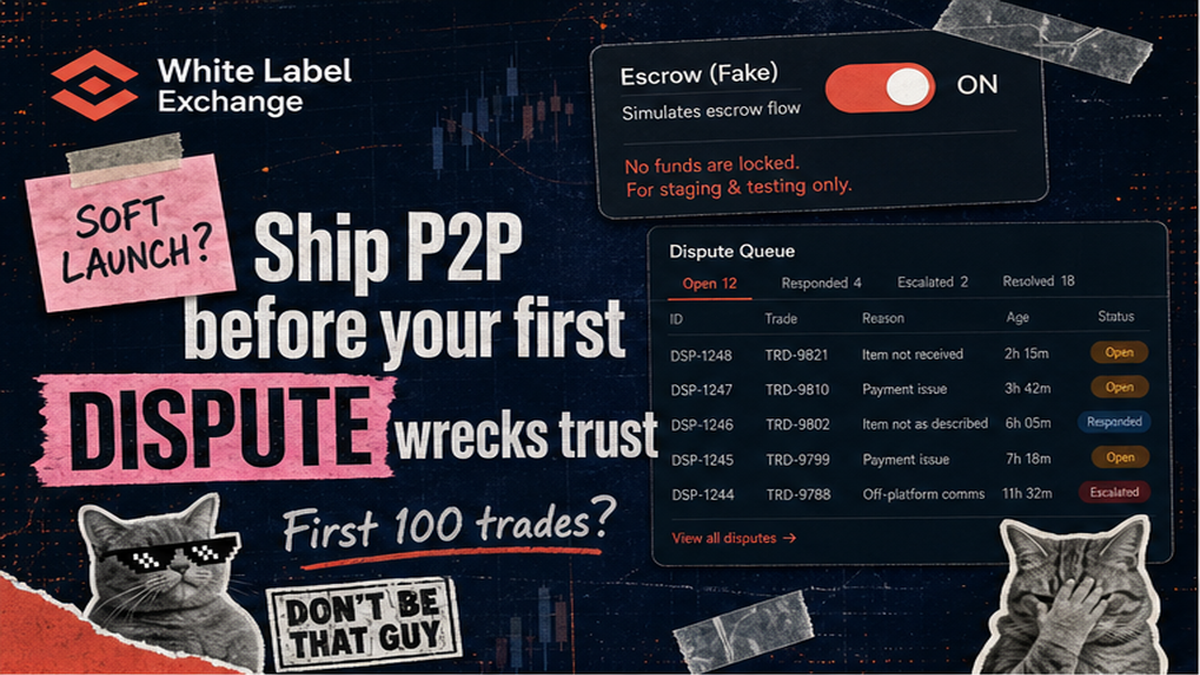
Most P2P launches stall after the first disputes, not after coding. A peer-to-peer crypto exchange is a branded marketplace where buyers and sellers trade directly while the platform holds crypto in escrow until payment clears. Use this operator checklist to lock the escrow model, ship only modules needed before first trade, wire dispute and KYC controls, map payment rails and seed liquidity, then soft-launch and survive the first 30 days.
TL;DR / Quick insight: Decide custodial, non-custodial, or hybrid escrow before you buy software. Ship an MVP with offers, escrow lock-release, chat with payment proof, disputes, wallets, and admin. Tier KYC so small trades stay light, define evidence rules per payment rail, run a closed beta with about 50–200 users, then operate month one with clear dispute SLAs and merchant quality checks.
Vendor blogs usually sell “build cost 2026.” Operators need a go-live sequence: model → modules → risk → rails → soft launch → first 30 days. Plain terms: escrow locks the seller’s crypto mid-trade; KYC is identity checks; AML screens illicit funds. Legal paths need counsel – software alone is not compliance.
1. Choose your escrow model: custodial, non-custodial, or hybrid
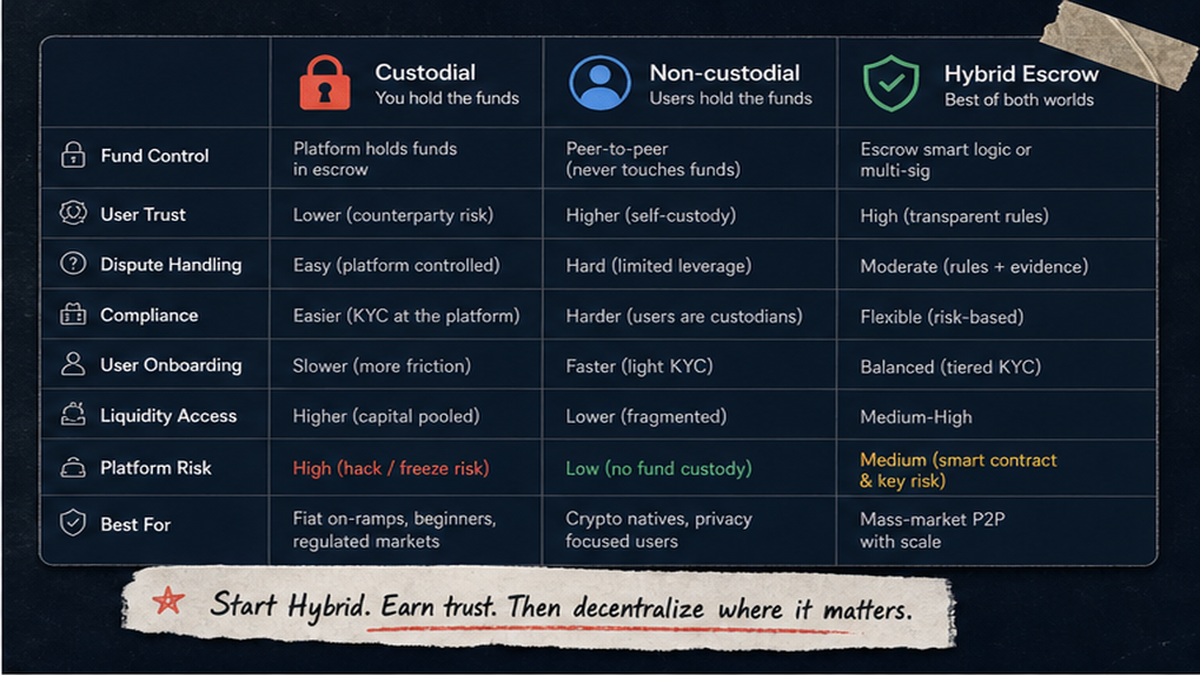
Do not start branding until you answer who holds the keys and who can release disputed funds. Industry guides describe three paths: custodial escrow (platform wallets), non-custodial or smart-contract escrow (on-chain lock), and hybrid mixes. Production setups often use a 2-of-3 multi-signature pattern (buyer, seller, platform) so one party cannot unilaterally seize funds.
| Decision | Custodial escrow | Non-custodial / on-chain | Hybrid |
|---|---|---|---|
| Who holds crypto during trade | Platform wallets | Smart contract lock | Mix by asset or tier |
| UX for first users | Usually simpler | Gas, wallet friction | Configurable |
| Compliance / custody load | Higher – you touch user funds | Lower custody, more on-chain ops | Depends on design |
| When to choose | Speed to market, fiat-heavy rails | Strong non-custody story | Most realistic MVPs |
Recommendation: Document the escrow model and key ceremony before go-live. Do pick one primary release path for disputes. Don’t leave “admin can always force-release” undocumented – that becomes a trust and audit problem later.
2. Build core modules before the first trade
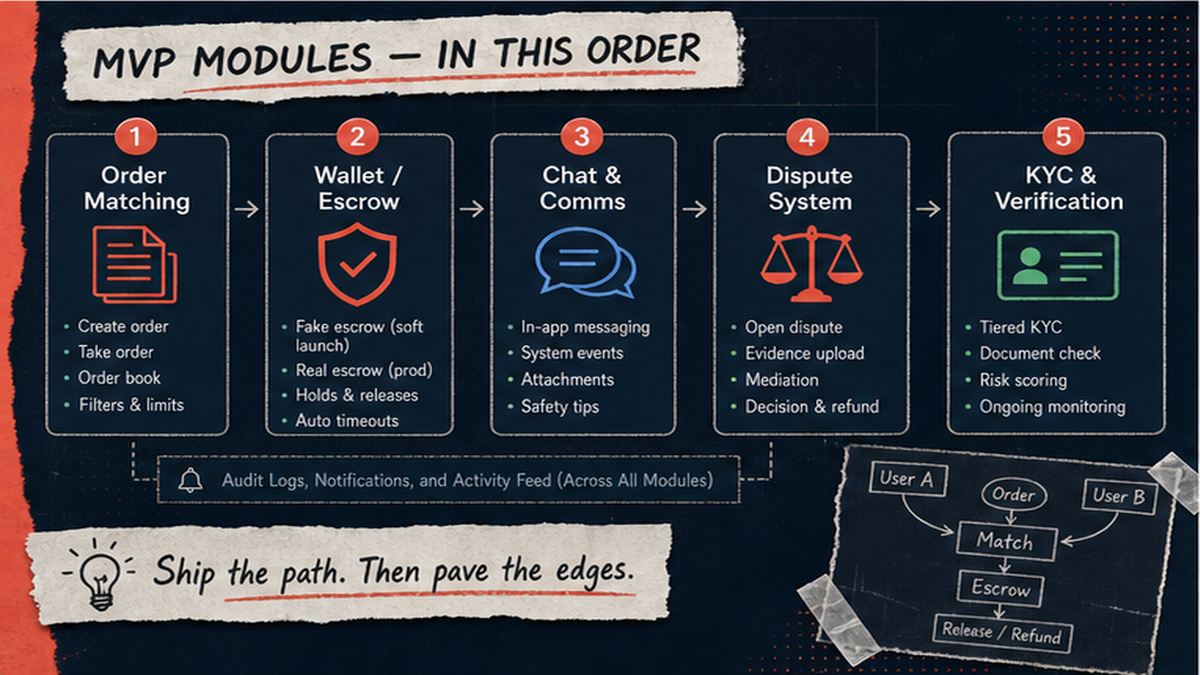
A workable MVP is smaller than most feature lists. Confirm these modules work end-to-end before public ads:
- Offer / ad board with filters (asset, fiat, payment method, limits)
- Escrow engine: lock, release, cancel, and dispute pause
- Trade timers (commonly around 30–60 minutes in industry write-ups)
- In-app chat plus file upload for payment proofs
- Dispute queue with evidence viewer and decision log
- Wallets with a hot / cold policy and withdrawal controls
- Basic admin roles (support, compliance, super-admin)
Do refuse enterprise extras until the first 100 trades complete cleanly. Don’t go live without chat-as-evidence – dispute teams need timestamped messages and proof files.
Build path is separate. Vendor-reported ranges (not White Label Exchange pricing) often cite script paths around $5,000–$20,000 (~4–8 weeks), white-label P2P around $15,000–$60,000 over weeks to a few months, and custom builds from about $50,000–$150,000+ over several months. Add a 30–40% buffer for disputes, KYC, rails, and audits. For a faster branded stack, review White Label Exchange and still validate escrow ownership and dispute maintenance. Broader frame: how to start a crypto exchange.
3. Configure dispute, KYC, and risk controls operators forget
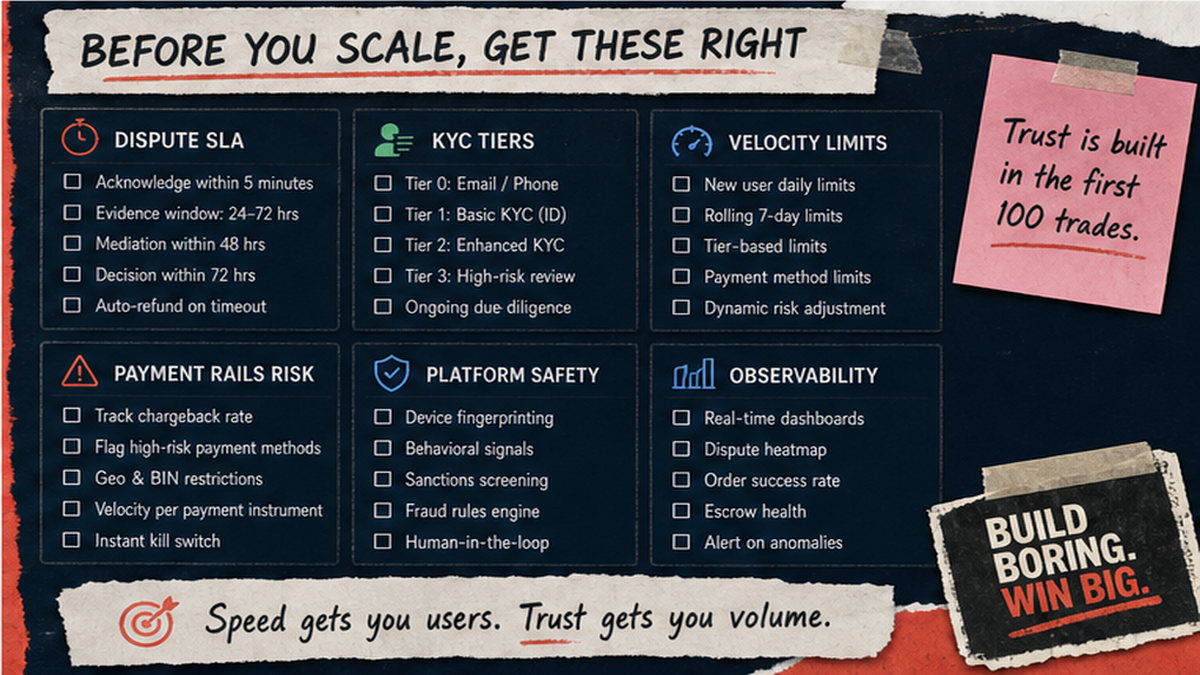
Weak dispute SLA kills new platforms faster than missing UI polish. Wire risk before marketing:
- Write outcome rules: when escrow releases to the seller, refunds the buyer, or stays frozen.
- Freeze escrow on dispute open; never let either side withdraw mid-case.
- Require chat history plus payment proof before a decision.
- Set an escalation SLA and log every decision.
- Connect tiered KYC: light checks for small trades, full ID for higher volumes; add AML / sanctions screening.
- Set fees and limits by verification tier.
- Flag high-risk rails with stricter evidence rules.
Workflow: Offer accepted → buyer pays via chosen rail → crypto stays in escrow → seller confirms or dispute opens → evidence reviewed → release / refund / escalate → decision logged.
Do drill disputes with fake cases before soft launch. Don’t force full KYC on every tiny trade on day one, and don’t skip screening on large tiers. See KYC, KYB, and AML for operators and how to handle customer disputes.
4. Setup liquidity and payment rails
Each payment rail needs its own fraud and evidence rules. Start narrow:
- Pick 3–5 local methods for your launch geography instead of 40 half-broken options.
- Define proof standards per rail: what counts as paid, what is reversible, and wait time before release.
- Onboard seed merchants who will post continuous ads on your top corridors.
- Set merchant reputation rules: completion rate, dispute rate, response time.
- Alert on stuck escrow and abnormal dispute spikes – not weekly spreadsheets alone.
Do prioritize corridor depth over vanity method count. Don’t launch with zero committed sellers on your top fiat pairs – empty boards look abandoned within hours.
5. Run the go-live checklist and first 30 days ops
Soft-launch practice from operator guides: invite about 50–200 users, load-test critical paths, run dispute drills, finish ToS / privacy / fee schedule, then open public marketing.
Before public launch – checklist
- Entity registered; crypto counsel engaged; licensing path documented (US MSB / EU MiCA-CASP / local VASP framing – counsel decides)
- Escrow model + key ceremony documented
- Offer board + filters live; escrow lock / release / cancel / dispute pause tested
- Trade timers configured; in-app chat + proof upload live
- Dispute queue with evidence viewer + decision log
- Tiered KYC + AML screening connected
- Hot / cold wallet policy + withdrawal controls; 2FA and admin role separation
- Fee schedule + limits by KYC tier; ToS, privacy, dispute policy published
- Support on-call for disputes; monitoring for stuck escrow and dispute-rate spikes
- Closed beta with invite cohort completed
First 30 days – checklist
- Track completion rate, average release time, dispute rate
- Review top failure rails weekly; enforce merchant reputation rules
- Keep liquidity on top pairs and fiat corridors
- Write incident postmortems within 48 hours of critical disputes
What kills new P2P platforms: weak dispute SLA, thin local payment coverage, no seed merchants, and KYC that is either missing or too heavy on day one. Fix those before you scale ads.
What to do next
- Write a one-page memo: custodial / non-custodial / hybrid + who can release disputed funds.
- Mark MVP modules done / not done against the list in section 2.
- Draft dispute outcome rules and KYC tiers with counsel and ops.
- Map 3–5 payment rails and name seed merchants for each top corridor.
- Schedule a closed beta week with dispute drills and monitoring alerts.
When you compare white-label P2P software against a longer custom build, explore solutions on whitelabelexchange.io or more operator guides on the White Label Exchange blog.
Material reviewed: White Label Exchange Editorial.
Data note: Cost, timeline, and module patterns attributed to industry vendor guides in research notes as of 16 July 2026. Search-demand volumes unavailable (Wordstat MCP unavailable); no fabricated counts. Vendor-reported ranges, not White Label Exchange pricing. Not legal or investment advice.
Frequently asked questions
What software do you need for a P2P crypto exchange?
Offer board, escrow lock-release, wallets with hot/cold policy, chat with payment-proof upload, dispute admin queue, KYC/AML hooks, and payment-method configuration. Script, white-label, or custom – the module floor stays the same.
How is a P2P exchange different from a spot exchange?
Spot matches an order book with the platform as venue. P2P matches user-to-user offers, holds crypto in escrow, and settles fiat on external rails. Ops burden shifts to disputes, merchant quality, and rail fraud.
How should you handle P2P disputes?
Freeze escrow, collect timestamped chat plus payment proof, apply written outcome rules, release or refund by policy, and log every decision. Drill this before public launch.
Should you choose custodial or non-custodial escrow?
Custodial is simpler for fiat-heavy users but increases custody load. Non-custodial or smart-contract escrow reduces custody but adds gas and wallet friction. Many launches use a hybrid – document release rules either way.
Is white-label P2P software enough to launch?
Often yes for MVP speed. Still validate code ownership, hosting lock-in, who maintains escrow/dispute logic, and whether counsel accepts the custody model. Legal timelines can still exceed engineering work.
What usually kills new P2P platforms after launch?
Slow dispute handling, thin local payment coverage, no seed merchants, and KYC that is either absent on large trades or so heavy on day one that nobody completes a first trade.
How long does it take to launch a P2P crypto exchange?
Vendor bands often put white-label in weeks to a few months and custom builds in several months, plus legal timelines. Soft launch and dispute drills matter – “code complete” is not “operator ready.”