Crypto Market Making for New Exchanges: Operator Checklist
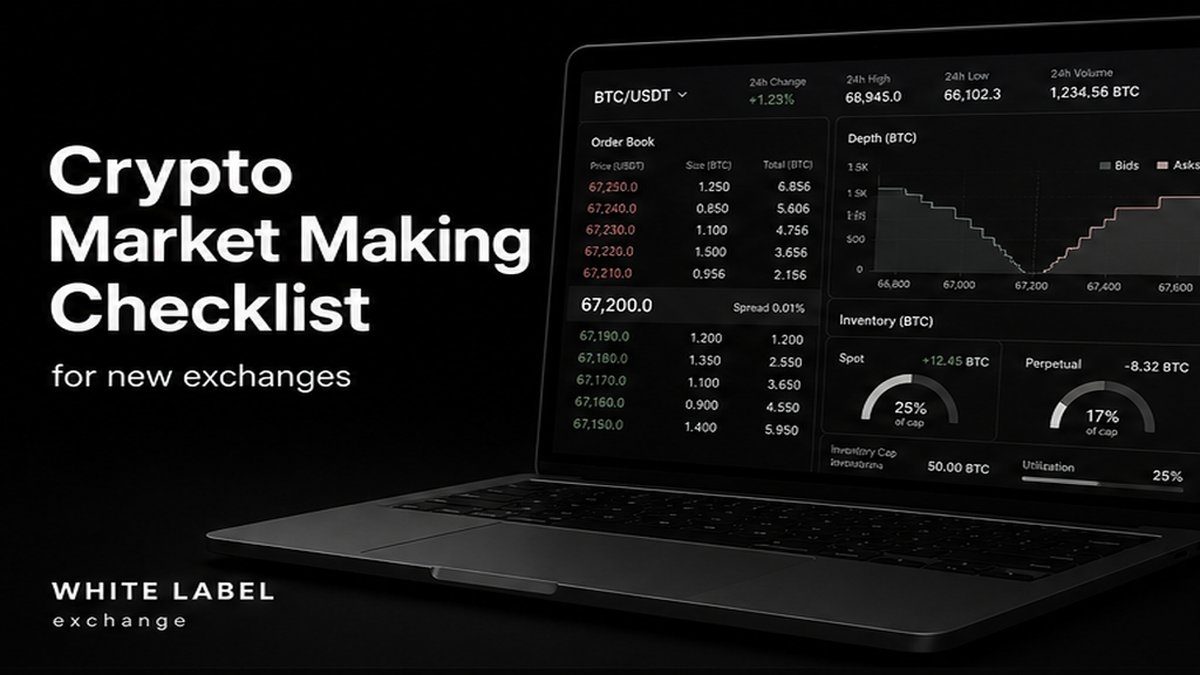
An empty order book on day one turns early traders into unhappy critics. Crypto market making means posting continuous buy and sell quotes so users can trade without waiting for a lucky match. This operator checklist helps you lock pairs, depth, and inventory caps, pick a firm vs in-house vs LP API model, write enforceable spread and skew rules, wire monitoring, then run a 14-day MM go-live with clear exit criteria.
Summary: Write the MM brief before any pitch: pairs, min depth at a set mid-distance, max bid-ask spread, and hard inventory caps. Score firm vs in-house vs hybrid LP API by capital, control, time-to-live, and inventory risk owner. Contract spread, depth, and uptime together with skew and kill-switch rules, soft-open staged sizes, then go or no-go by day 14.
For aggregation-first liquidity, fees, and depth metrics, use the liquidity playbook for new exchanges. Keep this page for market-making operations after that foundation exists.
Define pairs, depth targets, and inventory caps before hiring
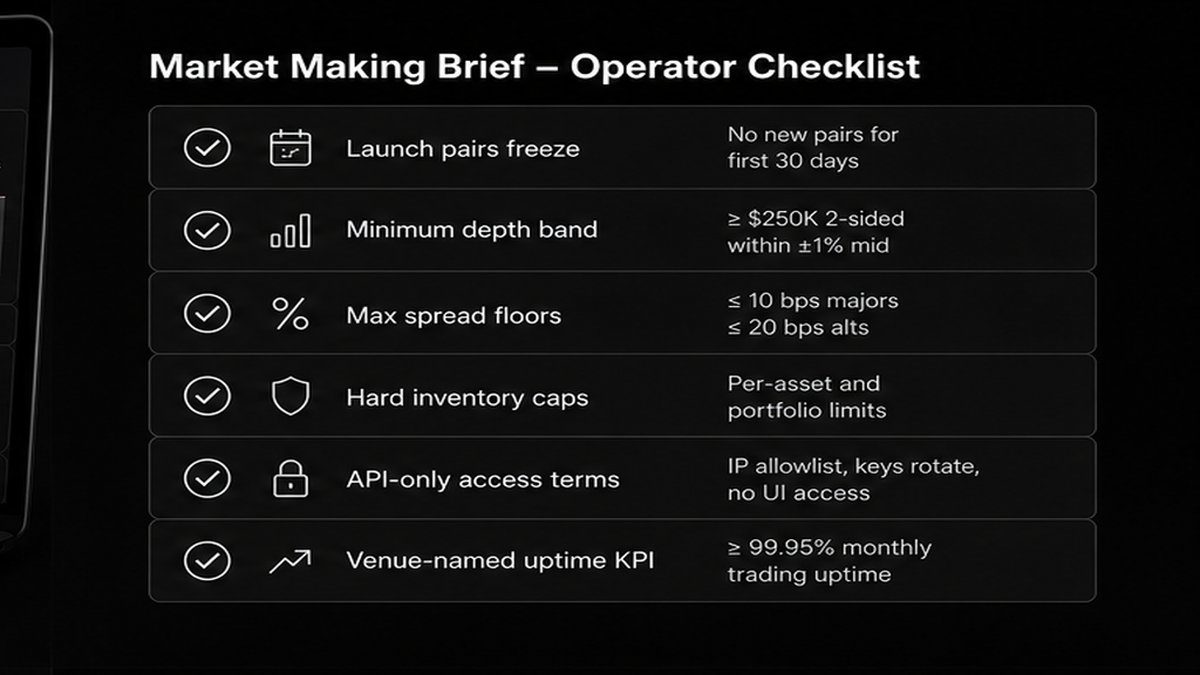
Market making only works if the venue states what “good” looks like. Start with a short list of launch pairs. For each pair, write the minimum depth inside a distance-from-mid band (many desks treat the zone around ±2% of mid as the active book) and the widest bid-ask spread you will tolerate in calm sessions.
Inventory risk is the directional pile-up you get when one side of flow keeps hitting your quotes. Cap how much base and quote asset an MM may hold, and name who posts collateral if balances move. Prefer non-custodial or API-only access to treasury; opaque custody without collateral terms is a diligence red flag.
Watch out: pitching vendors before numbers exist invites vague slides. Bring a one-page brief with pairs, depth, spread floors, inventory caps, and your venue name on the KPI list.
- List launch pairs and freeze the set for the first soft-open window.
- Set min depth inside a stated distance-from-mid band for each pair.
- Cap max bid-ask spread for calm hours and a wider floor for volatility.
- Write hard inventory caps and who owns the risk when caps trip.
- Require API-only or non-custodial access terms before sharing keys.
- Name your venue explicitly in any uptime or presence KPI list.
MM agreements often take weeks to negotiate. Start the brief early so ops is not racing exchange launch.
Compare MM models: external firm vs in-house vs hybrid LP API
A liquidity provider (LP) is anyone supplying tradable size. A market maker is a type of LP that posts two-sided quotes on your central limit order book under presence, size, and spread obligations. An LP API (liquidity provider application programming interface) streams prices and sizes from external books into yours, often as a hybrid with lighter quoting duties.
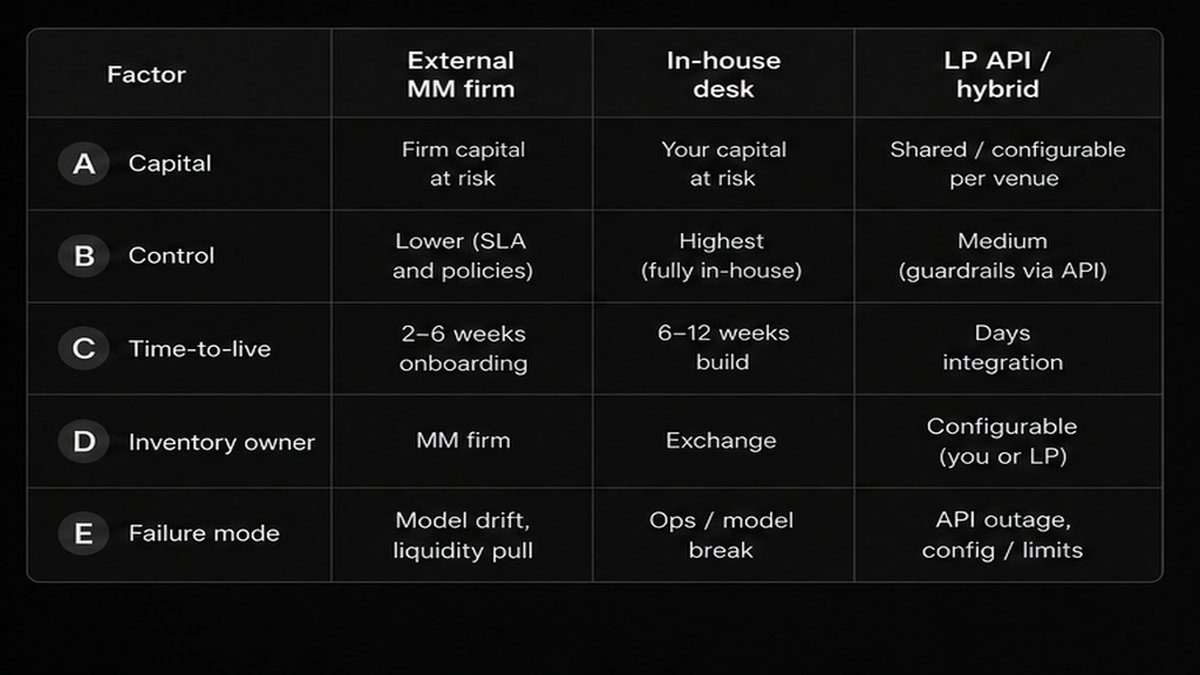
New venues often bootstrap with aggregated or API liquidity first, then add bilateral MM on core pairs once organic flow appears. In-house desks buy pricing control but lock capital and staffing cost. Hybrid LP API setups lower upfront desk cost, yet a single provider can become a single point of failure if you never track share of book or exit terms.
| Criteria | External MM firm | In-house desk | LP API / hybrid |
|---|---|---|---|
| Capital | Retainer plus inventory rules | High locked inventory capital | Lower upfront desk cost |
| Control | Contract KPIs, less day control | Full pricing and inventory control | Shared control with feed owners |
| Time-to-live | Weeks after brief and legal | Months to staff and model | Days to weeks after sandbox |
| Inventory owner | Firm under written caps | Exchange balance sheet | Mixed; often LP-side risk |
| Failure mode | Quotes pull if KPIs weak | Ops gaps in volatile hours | Feed drop or one LP dominates |
Score each column against capital and headcount. Make sure exit and cure clauses exist before live quotes: fee cut, cure window, then terminate. Most new CEXs start hybrid. Test FIX, REST, or WebSocket sandboxes under volatile sessions and record reject rates plus reconnects.
Configure spread, size, and skew rules for first-week volatility
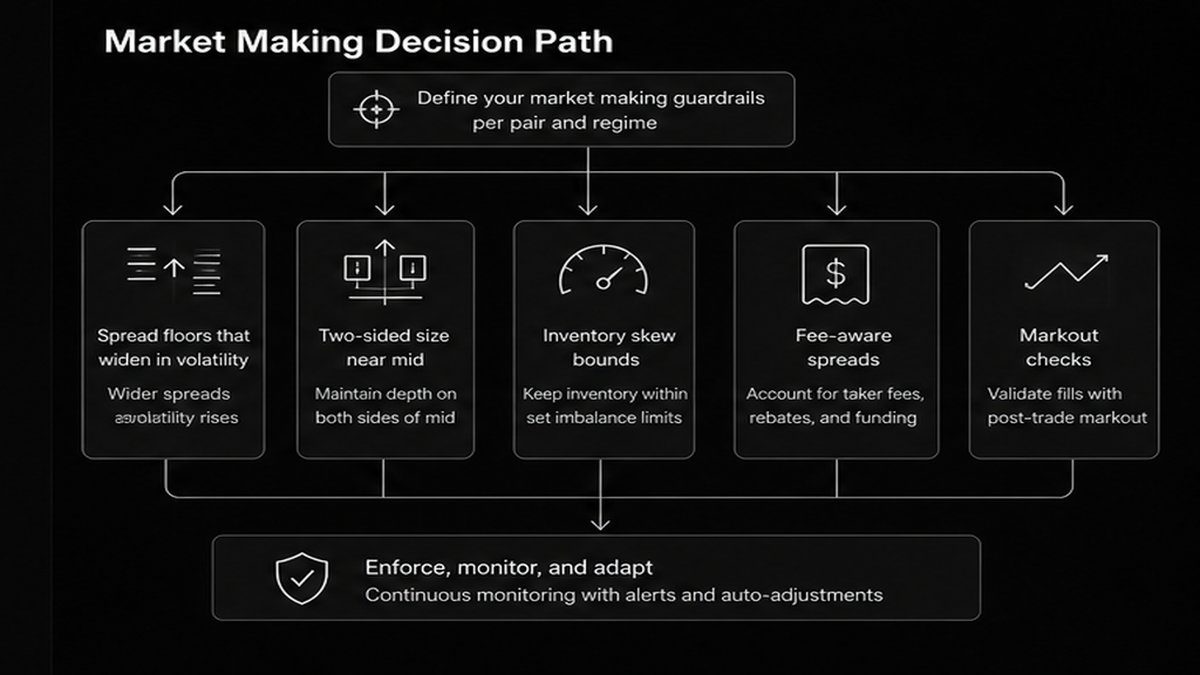
Spread is the gap between the best bid and best ask. Size ladders say how much you show at each price level. Skew means leaning quotes away from inventory you already hold so you do not keep buying more of the same asset when flow is one-sided.
Enforceable MM KPIs are a triad that must hold together: spread, depth, and uptime. Depth needs a distance-from-mid definition. Uptime needs a sampling frequency and a venue list that names your market. A missed KPI without a remedy clause has no force.
- Spread floors that widen in volatility instead of vanishing.
- Minimum two-sided size near mid, with a clear farther ladder.
- Inventory skew rules with hard bounds and who may pause quoting.
- Fee-aware spreads so maker rebates do not hide toxic fills.
- Markout checks after fills to spot adverse selection early.
A common miss is writing only “tight spreads” without sampling rules, venue naming, and cure language. Another miss is promising 100% uptime; serious algo LPs often aim for high quoting uptime in the mid-to-high nineties as practice, not a marketing SLA. Start with calm-session targets, then write volatile-session floors in the same document. Avoid oral side deals that never hit the runbook.
Wire monitoring for depth, slippage, fills, and inventory alerts
Dashboards should show spread versus target, inventory and skew, fill and reject rates, and circuit breakers. Slippage on small market orders proves depth is real. Failed fills and reconnect storms often appear before the book looks empty on a screenshot.
- Alert when depth inside your band falls below the contracted floor.
- Alert when spread stays wider than the floor across N samples.
- Page ops on inventory approaching hard caps or skew limits.
- Log reject rates and failed cancels during volatile windows.
- Test the kill switch or cancel-all path in staging before soft-open.
- Track each provider’s share of near-book depth weekly.
Treat the kill switch as a rehearsed drill. If quotes cannot be pulled fast, inventory caps alone will not save you when flow flips. Soft next step: review options on the White Label Exchange homepage or the white-label vs build guide if you still need branded spot rails.
Run a 14-day MM go-live checklist and exit criteria
Soft-open with staged sizes. Measure markouts and rejects under load before you advertise deep markets. Day 14 is a decision gate.
- Confirm sandbox latency, fills, and reconnects under a volatile replay.
- Enable staged quote sizes on launch pairs only.
- Verify spread, depth, and uptime samples on your venue for seven days.
- Review inventory breaches, skew events, and kill-switch drills.
- Score provider concentration and cure notices, if any.
- Decide go, extend pilot, or exit under the written clause.
Workflow in plain order: targets first, then model pick, then KPI contract, then skew rules, then monitoring plus kill switch, then soft open, then day-14 go or no-go. For founders still scoping the venue, see how to start a crypto exchange.
Material checked: White Label Exchange Editorial.
Data notes: Operational claims follow cited industry sources in research (Tokenomist KPI framing, CCXT MM risk controls, B2Broker sourcing patterns, PlaceholderMM 2026 diligence themes). Ahrefs keyword volumes were unavailable for this run and are not invented. No Wordstat data applies to this English article.
Frequently asked questions
What is market making in crypto?
It is continuous two-sided quoting so buyers and sellers can trade against posted bids and asks. Profit for the maker is the spread minus losses from inventory drift and adverse selection. On a CEX this usually means quoting a central limit order book.
How much liquidity does a new exchange need?
Enough that small market orders see acceptable slippage inside your published depth band, not a vanity volume number. Set pair-level depth and spread targets first, measure during soft-open, then scale. Use the linked liquidity playbook for aggregation-first sizing rather than guessing a single dollar figure here.
What is the difference between a market maker and a liquidity provider?
Every market maker is a liquidity provider, but not every LP is an MM. LPs can be passive depth or API feeds without continuous two-sided obligations. MMs accept presence, size, and spread duties and manage inventory risk when flow is one-sided.
What are market maker KPIs (spread, depth, uptime)?
Write them as a package that must hold at the same time. Define depth with distance-from-mid, uptime with sampling frequency and your venue on the list, and attach cure or terminate language when any leg fails.
How do crypto exchanges source liquidity?
Common patterns are aggregated or API liquidity, bilateral MM programs with obligations, and later in-house desks once organic flow exists. Test providers in sandbox under stress, avoid single-provider concentration, and negotiate exit terms early.
What is a non-custodial market making model and why does it matter?
Non-custodial or API-only models keep treasury control on your side while the MM quotes through keys and collateral rules. Opaque custody without clear collateral and exit terms raises operational and counterparty risk.
Aggregation or market making – which comes first?
Aggregation or LP API usually comes first to seed a usable book, then bilateral MM on core pairs once you can measure organic flow. This article covers MM ops after that choice; the liquidity playbook covers aggregation and fee bootstrap.